Jeopardy
Dive into the fundamental concepts of the scientific method, chemical bonds, and the properties of matter. This comprehensive overview covers key questions about variables, hypotheses, states of matter, atomic structure, and how elements interact. Explore the roles of protons, electrons, and neutrons within atoms, as well as the significance of the periodic table in identifying elements and their properties. This educational resource is ideal for students and anyone interested in enhancing their scientific knowledge.

Jeopardy
E N D
Presentation Transcript
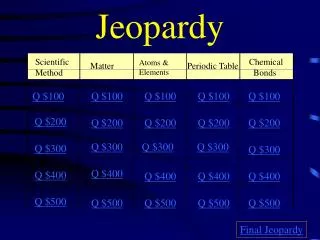
Jeopardy Scientific Method Chemical Bonds Atoms & Elements Matter Periodic Table Q $100 Q $100 Q $100 Q $100 Q $100 Q $200 Q $200 Q $200 Q $200 Q $200 Q $300 Q $300 Q $300 Q $300 Q $300 Q $400 Q $400 Q $400 Q $400 Q $400 Q $500 Q $500 Q $500 Q $500 Q $500 Final Jeopardy
$100 Question from Scientific Method Name two types of variables in an experiment.
$100 Answer from Scientific Method Dependent & Independent Variables
$200 Question from Scientific Method What do we call an educated statement that can be tested?
$200 Answer from Scientific Method Hypothesis
$300 Question from Scientific Method We use our senses to make ___________ about the world around us.
$300 Answer from Scientific Method Observations
$400 Question from Scientific Method In an experiment, which variable do you intentionally change?
$400 Answer from Scientific Method The independent variable
$500 Question Scientific Method What is the correct order of the steps in the scientific method? A) Ask questions, make a hypothesis, test the hypothesis, analyze results, draw conclusions, communicate results. B) Make a hypothesis, test the hypothesis, analyze the results, ask a question, draw conclusions, communicate results. C) Ask a question, analyze results, make a hypothesis, test the hypothesis, draw conclusions, communicate results. D) Ask a question, make a hypothesis, test hypothesis, draw conclusions, analyze results, communicate results.
$500 Answer from Scientific Method A) Ask questions, make a hypothesis, test the hypothesis, analyze results, draw conclusions, communicate results.
$100 Question from Matter Fill in the blank: Matter is anything that has ________ and takes up space.
$200 Question from Matter What are the four states of matter?
$200 Answer from Matter Solid, Liquid, Gas, Plasma
$300 Question from Matter Tiny particles that make up matter are called ________.
$300 Answer from Matter Atoms
$400 Question from Matter Matter can undergo physical and chemical changes. Burning a piece of paper is an example of a ________ change.
$400 Answer from Matter Chemical change
$500 Question from Matter When matter changes phase from a gas to a liquid, the process is called ____________.
$500 Answer from Matter Condensation
$100 Question from Atoms & Elements Positive or negative? An electron has a _________ charge and a proton has a _____________ charge.
$100 Answer from Atoms & Elements An electron has a negative charge and a proton has a positive charge.
$200 Question from Atoms & Elements • Where in the atom would you find the protons and neutrons?
$200 Answer from Atoms & Elements Inside the nucleus
$300 Question from Atoms & Elements The Lewis Dot Structure shows the number of what?
$300 Answer from Atoms & Elements Valence electrons
$400 Question from Atoms & Elements On the periodic table, what is the family name for the elements in Group 1 Group 7 Group 8
$400 Answer from Atoms & Elements Group 1: Alkali Metals Group 7: Halogens Group 8: Noble Gases
$500 Question from Atoms & Elements Use the image to find the number of: Protons: Neutrons: Electrons:
$500 Answer from Atoms & Elements P = 17 E = 17 N = 18 or 18.45
$100 Question from Periodic Table What does the atomic number tell us about the element?
$100 Answer from Periodic Table The number of protons. (Which also equals the number of electrons)
$200 Question from Periodic Table What was the name of the scientist who organized the elements on the periodic table?
$200 Answer from Periodic Table Dmitri Mendeleev
$300 Question from Periodic Table The atomic mass is equal to the number of _______ + _________.
$300 Answer from Periodic Table Protons + Neutrons
$400 Question from Periodic Table On the periodic table, the groupnumber tells us the number of_____________________ And the periodtells us the number of __________________.
$400 Answer from Periodic Table Group number = number of valence electrons Period number = number of shells / orbitals.
$500 Question from Periodic Table From memory what are the names of the elements for these 5 symbols? Ca C O Au He
$500 Answer from Periodic Table Ca = Calcium O = Oxygen He = Helium C = Carbon Au = Gold
$100 Question from Bonds What are the two types of bonds we learned about?
$100 Answer from Bonds Covalent Bonds & Ionic Bonds
$200 Question from Bonds The elements in which group on the periodic table do not like to form bonds?
$200 Answer from Bonds Noble Gases (Group 8)
$300 Question from Bonds What is an ion?
$300 Answer from Bonds An atom with a charge
$400 Question from Bonds How does an atom become an ion?
$400 Answer from Bonds It loses or gains an electron.
$500 Question from Bonds • In which type of chemical bonds do atoms share electrons? __________ • In which type of chemical bonds do atoms donateelectrons to another atom? __________