What a Difference Exercise Makes!
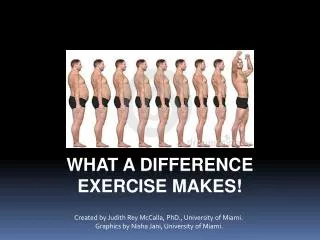
This analysis, created by Dr. Judith Rey McCalla from the University of Miami, explores how different activity levels affect caloric balance and weight change. The study compares four individuals: Adam, Peter, Mark, and John, showcasing the difference exercise makes on calories burned daily and yearly. Adam, the most active, burns an excess of 91,000 calories a year, leading to weight loss. In contrast, Peter maintains his weight, while Mark gains 6 pounds, and John, the couch potato, accumulates 21 pounds annually. This highlights the significance of exercise in weight management.

What a Difference Exercise Makes!
E N D
Presentation Transcript
What a Difference Exercise Makes! Created by Judith Rey McCalla, PhD., University of Miami. Graphics by Nisha Jani, University of Miami.
ADAM VERY ACTIVE
ADAM Eats: 2,000 calories / day Burns: 2,250 calories/day 2,000 – 2,250 = 250 more calories burned per day 7 days/week x 250 = 1,750 more calories burned/week 1,750 x 52 weeks/year = 91,000 more calories burned per year
ADAM 3,500 calories = 1 pound 91,000 3500 = 26 pounds per year that Adam will LOSE.
PETER ACTIVE
PETER Eats: 2,000 calories / day Burns: 2,000 calories/day 2,000 – 2,000 = 0 extra calories per day 7 days/week x 0 = 0 extra calories per week 0 x 52 weeks/year = 0 extra calories per year
PETER Peter’s weight will remain the same.
MARK SOMEWHAT ACTIVE
MARK Eats: 2000 calories / day Burns: 1940 calories/day 2000 – 1940 = 60 extra calories per day 7 days/week x 60 = 420 extra calories per week 420 x 52 weeks/year = 21,840 extra calories per year
MARK 3,500 calories = 1 pound 21,840 3,500 = 6 pounds per year that Mark will GAIN.
JOHN COUCH POTATO
JOHN Eats: 2,000 calories / day Burns: 1,800 calories/day 2,000 – 1,800 = 200 extra calories per day 7 days/week x 200 = 1,400 extra calories per week 1,400 x 52 weeks/year = 72,800 extra calories per year
JOHN 3,500 calories = 1 pound 72,800 3,500 = 21 pounds per year that John will GAIN.







![[Exercise Name]](https://cdn2.slideserve.com/4369850/exercise-name-dt.jpg)