Breaking Barriers
"Breaking Barriers" delves into two pivotal events in American civil rights history: Brown vs. Board of Education and Rosa Parks' Bus Boycott. The 1954 Supreme Court ruling ended legal segregation in public schools, sparked by Oliver Brown's fight for his daughter Linda's right to attend a closer white school. Simultaneously, Rosa Parks' refusal to give up her bus seat ignited a year-long boycott that challenged racial injustices in Montgomery, Alabama. Together, these cases symbolize the courage and determination of African Americans in their struggle for equality.

Breaking Barriers
E N D
Presentation Transcript
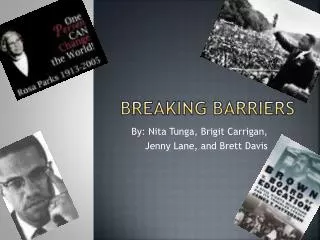
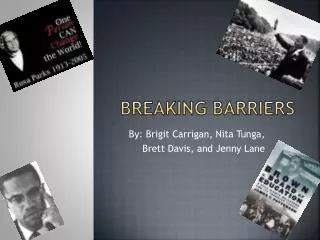
Breaking Barriers By: Brigit Carrigan, Nita Tunga, Brett Davis, and Jenny Lane
The case of the century: Brown Vs. board Education Nita Tunga
Brown vs. board of education background info • Linda Brown, daughter of Oliver Brown, was required to attend an African American school • The school was on the other side of town • However, there was a white school only seven blocks away • When her parents tried enrolling her in the white school, their request was denied • Her parents sued the Board of Education, which created the basis for Brown vs. Board of Education
The case background info • Five states were involved in the Brown vs. Board of Education: Kansas (Oliver Brown was from here), Delaware, District of Columbia, South Carolina, and Virginia • The case occurred in 1954 • Plessy vs. Ferguson had set the stage for the Brown vs. Board of Education case
Brown vs. board of education • In 1954, the Supreme Court ruled segregation laws unconstitutional
The case • Oliver Brown sued the Board of Education for denying his daughter the right to attend the white school close to his house • He was part of the NAACP (National Association for the Advancement of Colored People) • NAACP was an organization that was trying to convince the Board of Education to improve black schools
Rosa Parks bus boycott Brigit Carrigan
Rosa Parks Bus boycott • On December 1st, 1955, forty-two year old seamstress Rosa Parks refused to give up her seat. • The Bus Boycott occurred in Montgomery, Alabama. • The bus driver asked her to give up her seat because a man walked on the bus, but she refused. • She was sitting towards the middle of the bus and he wanted her to move to the back.
Rosa parks bus boycott • She was arrested because she “violated a city ordinance” and violated the “laws of segregation”. • This event was called the “Bus Boycott”. • She and many other decided to not ride to bus. • Martin Luther King Jr. was the leader of the Bus Boycott.
Rosa parks bus boycott • African-Americans were about 75% of the total people riding the bus in Montgomery, Alabama. • The Bus Boycott lasted 382 days. • Rosa led African-Americans to freedom and equality.