DNA
DNA, or Deoxyribonucleic Acid, is the molecule that stores genetic information essential for life. Comprised of millions of nucleotides, each nucleotide contains a sugar (deoxyribose), a phosphate group, and one of four nitrogen bases: adenine (A), thymine (T), guanine (G), and cytosine (C). The iconic double helix structure was discovered by James Watson and Francis Crick in 1953. DNA replication occurs during the S-phase of interphase and involves unwinding the strands, pairing nucleotides, and polymerizing the new strands, ensuring accurate genetic transmission with mutation correction mechanisms.
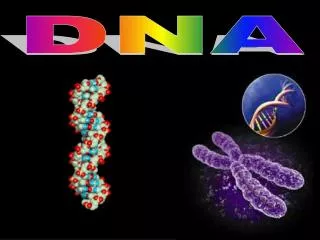

DNA
E N D
Presentation Transcript
Deoxyribonucleic Acid • Defined: Molecule that stores genetic information • Nucleotides: Three repeating units of nucleic acids • 1) Sugar • 2) Phosphate Group • 3) Nitrogen Base • Millions of nucleotides per strand of DNA
How many Nucleotides?
Nucleotides • Sugar (Deoxyribose) connects with the phosphate group • 4 Different Bases: • Adenine (A) • Thymine (T) • Guanine (G) • Cytosine (C) • Rule: A always joins with T • Rule: C always joins with G • Human DNA: ~3 billion pairs C T A A T G T
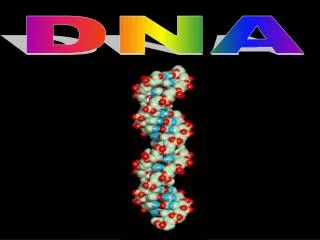
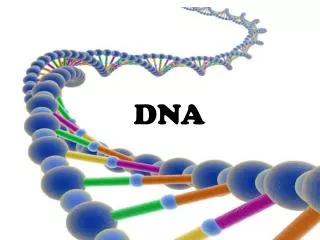
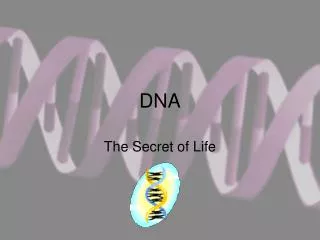
Double Helix • James Watson and Francis Crick identified DNA’s structure in 1953 • Double Helix: spiral shape of DNA • Left and right nucleotide strands are connected by a hydrogen bond
DNA Replication • Defined: Process of copying DNA • During interphase (S-stage) • Step 1: DNA Helicase “unzips” the two DNA strands (breaks the H bonds) • Step 2: Free floating nucleotides (A, T, C, G) match up • Step 3: DNA Polymerase reconnects the two strands
DNA Polymerase Glues the DNA T A A T G C G C Two Identical Strands of DNA! A T C G T A A T G C G C C G T A C G A T DNA Helicase Splits the DNA
Accuracy & Repair • Mutation: change in DNA sequence • Mutations can be corrected • Enzyme “proofreads” DNA and check/correct errors • Pre-repair: 1 in 10,000 nucleotides has an error • Post-repair: 1 in 1 billion nucleotides has an error
Quick Review • DNA nucleotides form long chains • DNA nucleotides have 4 different bases (A, T, C, G) • DNA makes exact copies of itself