
Integrated Services Digital Network (ISDN): Connecting Users Seamlessly
E N D
Presentation Transcript
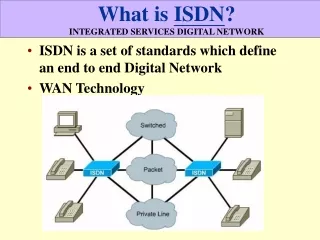
Integrated Services Digital Network • Public networks are used for a variety of services • Public Switched Telephone Network • Private Lines (leased) • Packet Switched Data Networks • Circuit Switched Data networks
ISDN • Users have a variety of equipment to connect to public networks • Telephones • Private Branch Exchanges • Computer Terminals or PCs • Mainframe Computers • A variety of physical interfaces and access procedures are required for connection
ISDN • The telephone network has evolved into a digital one with digital exchanges and links • The signalling system has become a digital message-oriented common channel signalling system (SS#7) • The term ‘Integrated Digital Network’ is used to describe these developments
ISDN • The Public Switched Telephone network is still analogue from the subscriber to the local exchange • The need has arisen to extend the digital network out to subscribers and to provide a single standardised interface to all different users of public networks • ISDN fulfils that need
Figure 15-1 ISDN Services The McGraw-Hill Companies, Inc., 1998 WCB/McGraw-Hill
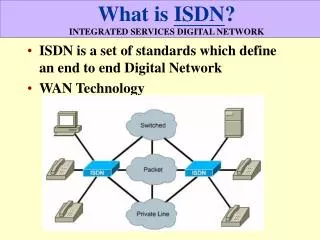
Integrated Services Digital Network Packet switched network Telephone Circuit switched network Data terminal Customer ISDN Interface ISDN central office PBX Databases Alarm ‘Digital pipe’ Other Networks & services LAN
Figure 15-4 Analog and Digital Services The McGraw-Hill Companies, Inc., 1998 WCB/McGraw-Hill
Figure 15-5 Integrated Digital Network The McGraw-Hill Companies, Inc., 1998 WCB/McGraw-Hill
Figure 15-6 Integrated Services Digital Network The McGraw-Hill Companies, Inc., 1998 WCB/McGraw-Hill
ISDN • In Practice there are multiple networks providing the service nationally • The user however, sees a single network
Benefits to Subscribers • Single access line for all services • Ability to tailor service purchased to suit needs • Competition among equipment vendors due to standards • Availability of competitive service providers
Architecture Integrated Digital Network Digital circuit- switched backbone Common physical interface ISDN central office Packet-switched network ISDN subscriber loop Basic 2B+D Primary 30B+D Network-based processing services
ISDN Channels • The Digital pipe is made up of channels - one of three types • B channel, D channel or H channel • Channels are grouped and offered as a package to users
B Channel • B channel-64 kbps • B is basic user channel • can carry digital data or PCM-encoded voice • or mixture of lower rate traffic.
B Channel • Four kinds of connection possible • Circuit-switched • Packet-switched - X.25 • Frame mode - frame relay (LAPF) • Semipermanent - equivalent to a leased line
D Channel • D Channel - 16 or 64 kbps • Carries signalling information to control circuit-switched calls on B channels • Can also be used for packet switching or low-speed telemetry
H Channel • Carry user information at higher bit rates 384kbps or 1536kbps or 1920kbps • Can be used as a high-speed trunk • Can also be subdivided as per user’s own TDM scheme • Uses include high speed data, fast facsimile, video, high-quality audio
ISDN Channel Groupings • Basic Access - • two 64 kbps B channels • plus one 16kbps D channel • B channels can be used for voice and data • simultaneous calls to separate destinations supported • D channel used for signalling and also for data using X.25
ISDN Basic Access • Intended for small business and residential use • A single physical interface is provided • Data rate is 144kbps plus 48kbps overhead bits totalling 192 kbps • Most existing subscriber loops can support basic access
Figure 15-7 Basic Rate Interface The McGraw-Hill Companies, Inc., 1998 WCB/McGraw-Hill
Figure 15-17 BRI Frame The McGraw-Hill Companies, Inc., 1998 WCB/McGraw-Hill
ISDN Primary Access • Intended for users with greater capacity requirements • Example would be a digital PBX • Two standards exist • 1.544 Mbps American • 2.048 Mbps European
PRI Frame Figure 15-20 The McGraw-Hill Companies, Inc., 1998 WCB/McGraw-Hill
Figure 15-8 Primary Rate Interface The McGraw-Hill Companies, Inc., 1998 WCB/McGraw-Hill
ISDN Primary Access • Typically it is structured as 30 B channels plus one 64kbps D channel (Europe) • Can also be structured as H channels • 5H0 +D for a 2.048 Mbps interface • or 1H12 +D
ISDN Primary Interface • Multiple channels multiplexed on single medium • Only point to point configuration is allowed • Typically supports a digital PBX and provides a synchronous TDM facility
User Access • Defined using two concepts • Functional groupings of equipment • Reference points to separate functional groupings
Typical User Access Layout ISDN Tele - phone NT 2-wire Subscriber Loop 4-wire S-bus PC with ISDN Interface Card User/network Interface Integrated Voice/data Terminal Up to 8 devices point to multi-point mode
Figure 15-9 Functional Grouping The McGraw-Hill Companies, Inc., 1998 WCB/McGraw-Hill
Figure 15-10 Reference Points The McGraw-Hill Companies, Inc., 1998 WCB/McGraw-Hill
Application Presentation Session Transport Network Datalink Physical ISDN Protocol Architecture End-end user signalling I.451/Q.931 call control X.25 packet level for further study X.25 packet level Frame Relay LAPB LAPD (Q921) Physical I.430 basic interface + I.431 primary interface
Figure 15-12 ISDN Layers for B and D Channels The McGraw-Hill Companies, Inc., 1998 WCB/McGraw-Hill
ISDN Data Link Layer • Link Access Protocol for the D channel (LAPD) defined for ISDN • Three applications are supported • Control Signalling • Packet Switching • Telemetry
B-Channel • Uses • Circuit Switching • Semi-permanent circuits • Packet switching
B-Channel • Circuit Switching • Circuit is set up on B-channel on demand • D-channel call control protocol is used • Transparent full-duplex digital data path established between users • Layers 2 to 7 are not visible to ISDN or specified
B-Channel • Semipermanent circuit can be set up by prior agreement between users and network operator • Can be for indefinite time or at specified times during day or week • As with circuit switched connection, full duplex digital data path is established • Layers 2 to 7 are not visible to ISDN or specified
D-Channel Packet Switching • Integrated X.25 service can be accessed by D-Channel in addition to B-Channel • ISDN provides a semi-permanent connection to a packet switching node within ISDN • The X.25 level 3 protocol is used for the packet layer • LAPD is used for the link layer