Download
1 / 17
170 likes | 285 Vues
Explore the fundamental elements and concepts of music, including representation, expression, and evocation. Learn about music genres, basic terminology, and the difference between music and noise. Delve into questions about morality in music and defining good versus bad music.

E N D
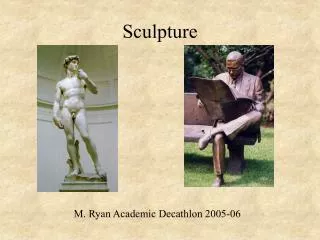
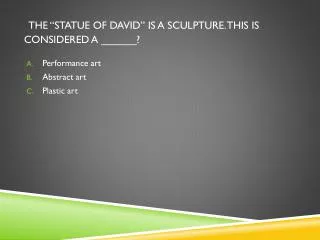
The “statue of David” is a sculpture. This is considered a ______? • Performance art • Abstract art • Plastic art
what is performance Art? • The use of tools to create a beautiful artwork. • An experience of beauty in a natural setting. • When artists use their voice or body to create an artwork
What is it called when an artwork tries to look like or recreate something from the real world • Expressive • Evoking • Representational
What is it called when an artwork tries to get an emotional response from the audience, trying to make the person feel something. • Expressive • Evoking • Representational
What is it called when an Artist creates an artwork to show an audience what the artist is feeling or thinking. • Expressive • Evoking • Representational
Music: • Music is the organization of sound and time. -Elliott Schwartz (composer) • Music is organized sound - EdgardVarèse • “Music is everything that one listens to with the intention of listening to music” (Berio, Dalmonte, and Varga) • Music is the universal language
Music: • Music is near universal phenomena, with almost all cultures practicing some form of music • Music may be: -representational -expressive -evocative
Music as Representation • Music is often meant to re-present or take things that are real and put them into sound: -dramatic stories -conflicts -natural sounds (thunderstorms, wind, rain, etc) -represent the mood of a place or event
Music as Expression • Music that is meant to share the thoughts and feelings of the composer with the audience/listener -often very emotional music, -can also be cognitive (sharing of thoughts through music not words) • Often meant to reflect the composer as a person
Music meant to evoke • Evoke means “audience response” or “listener reaction” • Music can affect the listener in 3 ways -to encourage imagination -to create feelings-new unnamed experience -to create emotions-recognized, and named feeling-states -to create a mood/atmosphere/mental state • The audience response to the music does not have to relate to what the composer intended. -the composer may be happy, but the music is sad
Music and Noise What is the difference between music and noise? -pleasing/unpleasant, agreeable/disagreeable, like/dislike -role of time -role of organization (either by listener or composer) -ex. Making music out of sounds on the street. -preview Nine inch Nails
Basic Elements of Music • Pitch-how high or low a sound is • Tone-The shape of the pitch, what it sounds like • Dynamics (how loud) • Duration-how long it lasts • Rhythm-the repetition or arrangement of musical elements
Music Terms: Note- the pitch or frequency of a sound, Western music uses A-G to indicate how high or low a relative sound is. Interval- The amount of difference in pitch between to sounds. Often based on math, equal distance between A, A#,A-, etc Harmony- The ability of specific notes to vibrate together Dissonance- 2 or more notes that do not make harmony. Chord- 2 or more notes that combine to make a pitch. Singing-using the voice to produce notes Scale-a pattern of notes that have precise intervals and can be played in harmony with chords.
Music Terms: Raga-(indian music scale) a series of notes that does not have precise intervals but stays in harmony with other instruments Key- indicates the scale being used to play, Key’s often relate to simple notes, the most popular being the Key of C (major or minor)
Music Genres • Classical –Western • Ethnic-relates to many various cultures around the world • Popular (Dance, Rock, Rap, Electronic, R&B, Reggae, etc) • Folk music-historical and traditional popular music of lower classes • Time period • Jazz • Opera • Musical
Questions • What is your idea of music? • Should music be morally and socially responsible? • What do you consider to be good music? What is different about good and bad music • Should we judge the quality of music based on its formal qualities, or our personal judgment. • Does music have to be beautiful/pleasant to be enjoyable or even useful?