Mastering French Regular -ER Verbs and Negation in the Present Tense
This lesson focuses on the essential elements of French regular -ER verbs, including their formation, conjugation, and usage in the present tense. You will learn about the infinitive forms, how to create negative sentences, and the role of adverbs in modifying verbs. Key verbs like "parler," "habiter," and "nager" are explored along with the necessary structures to express likes and dislikes. Practical examples illustrate how to navigate conversations effectively in French.

Mastering French Regular -ER Verbs and Negation in the Present Tense
E N D
Presentation Transcript
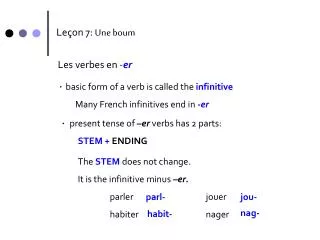
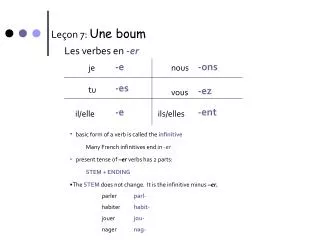
Leçon 7: Une boum Les verbes en -er -e -ons je nous -es tu -ez vous -e -ent il/elle ils/elles • basic form of a verb is called the infinitive • Many French infinitives end in-er • present tense of –erverbs has 2 parts: • STEM + ENDING • TheSTEMdoes not change. It is the infinitive minus–er. • parler parl- • habiter habit- • jouer jou- • nager nag-
Le verbeparler • = to speak • Regular –er verb (folllows a predicatable pattern) • Stem is parl- parle parlons je nous parles tu parlez vous parle parlent il / elle ils/elles NOTE: the –ent is silent
Le verbehabiter • = to live • Regular –er verb (folllows a predicatable pattern) • stem is habit- habite habitons j’ nous habites tu habitez vous habite habitent il / elle ils/elles • the –ent is silent • liaison when the verb begins with a vowel sound: aimer adorer étudier organizer inviter écouter
Le verbenager • = to swim • Regular –GER verb (folllows a predicatable pattern) • stem is nag- nage nageons je nous nages tu nagez vous il / elle nage nagent ils/elles • when the infinitive of a verb ends in –ger, the nous form ends in -geons manger: voyager: nous mangeons nous voyageons
La négation Negative sentences are formed as follows: Subject +NE + VERB + PAS N’ (+vowel sound) Éric et Anne ne parlent pas. Michèle n’habite pas en France Examples: J’aime la classe de français. Je n’aime pas la classe d’espagnol. Nous travaillons à la maison. Nous ne travaillons pas en vacances. Elles dansent bien. Elles ne chantent pas bien. Elle ne téléphone pas à sa cousine. Elle téléphone à une amie.
Language Comparisons English has several verb forms for expressing actions in the present. French has only ONE. Compare: I play tennis. I do play tennis. I am playing tennis. Je joue autennis. I do not play tennis. (I don’t play tennis.) I am not playing tennis.(I’m not playing tennis.) Je ne joue pas au tennis.
Les adverbes • Words used to modify verbs • Tell how often, how much, or how well Je nage bien. Je ne nage pas bien. Je veux bien nager. Subject +verb + adverb Subject + ne + verb + pas + adverb Subject + verb + adverb + infinitive NOTE: adverbs NEVER come between the subject and verb in French. Compare: Nous parlons toujours français. We always speak French. Tu joues mal au tennis. You play tennis badly.
La construction: verbe + infinitif Note the forms of the infinitive in the following sentences: J’aime parler français. I like to speak French. I like speaking French. Ils n’aiment pas danser. They don’t like to danse. They don’t like dancing. To express what you like & don’t like, use these constructions: SUBJECT + n’ PRESENT TENSE + pas + INFINITVE… of aimer SUBJECT + PRESENT TENSE + INFINITVE… of aimer Nous aimons voyager. Nous n’aimons pas voyager. The infinitive should also be used after the following expressions: Je préfère Je voudrais Je (ne) veux (pas) Est-ce que tu veux Je (ne) peux (pas) Je dois I prefer I would like I (don’t) want Do you want I can (can’t) I must / have to Je préfère travailler. Je voudrais voyager Je veux jouer. Est-ce que tu veux danser? Je ne peux pas dîner avec toi. Je dois étudier.