All Chevy Duramax Generations Explained Year by Year
0 likes | 1 Vues
Chevy Duramax engines have evolved through multiple generations, each bringing improvements in power, efficiency, and reliability. From the early LB7 to the latest L5P models, every generation introduced unique features, updates, and design changes. Understanding Duramax engines by year helps owners and enthusiasts identify specifications, performance upgrades, and compatibility. This year-by-year breakdown highlights key milestones, engine models, and technological advancements that shaped the Duramax legacy.

All Chevy Duramax Generations Explained Year by Year
E N D
Presentation Transcript
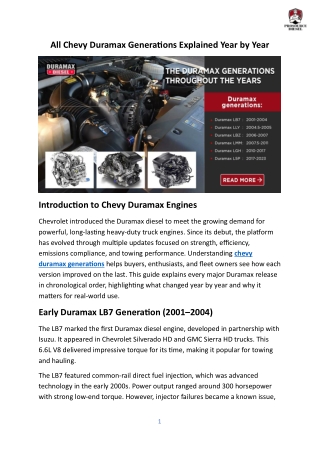
All Chevy Duramax Generations Explained Year byYear Introduction to Chevy Duramax Engines Chevrolet introduced the Duramax diesel to meet the growing demand for powerful, long-lasting heavy-duty truck engines. Since its debut, the platform has evolved through multiple updates focused on strength, efficiency, emissions compliance, and towing performance. Understandingchevy duramax generationshelps buyers, enthusiasts, and fleet owners see how each version improved on the last. This guide explains every major Duramax release in chronological order, highlighting what changed year by year and why it matters for real-world use. Early Duramax LB7 Generation (2001–2004) The LB7 marked the first Duramax diesel engine, developed in partnership with Isuzu. It appeared in Chevrolet Silverado HD and GMC Sierra HD trucks. This 6.6L V8 delivered impressive torque for its time, making it popular for towing and hauling. The LB7 featured common-rail direct fuel injection, which was advanced technology in the early 2000s. Power output ranged around 300 horsepower with strong low-end torque. However, injector failures became a known issue, 1
mainly due to internal injector placement under the valve covers. Despite this, many LB7 engines are still running today with proper maintenance. LLY Duramax Updates and Changes (2004–2005) The LLY replaced the LB7 mid-2004 and addressed several earlier concerns. A common question among buyers iswhat year is lly duramax, and the answer lies between late 2004 and 2005 model years. This generation introduced an external injector design, simplifying repairs. The LLY also added emissions-related updates, including an EGR system. While power remained similar to the LB7, some owners reported overheating issues when towing heavy loads. Even so, the LLY is valued for its improved injector reliability and smoother operation. LBZ Duramax Performance Improvements (2006–2007) Often considered one of the most desirable Duramax engines, the LBZ arrived in 2006. It combined strong factory performance with minimal emissions restrictions. Horsepower increased to around 360, with torque climbing to approximately 650 lb-ft. The LBZ used a stronger six-speed Allison transmission and improved internal components. Because it predates diesel particulate filters, it offers excellent tuning potential and reliability. Many enthusiasts regard the LBZ as a balance of power, durability, and simplicity. LMM Duramax and Emissions Upgrades (2007–2010) The LMM generation introduced major emissions changes, most notably the diesel particulate filter (DPF). This update was necessary to meet stricter environmental regulations but added complexity. While power figures remained similar to theLBZ, fuel economy could drop during DPF regeneration cycles. The LMM continued using the proven Allison transmission and remained capable for towing. Owners who prioritize emissions compliance with solid performance often consider this generation. 2
LML Duramax Technology Advancements (2011–2016) The LML Duramax brought significant technological upgrades. It introduced a high-pressure CP4 fuel pump and selective catalytic reduction (SCR) using diesel exhaust fluid (DEF). These changes allowed higher power output, reaching up to 397 horsepower and 765 lb-ft of torque. Improved fuel economy and cleaner emissions were clear benefits. However, CP4 pump failures became a known concern, potentially causing costly fuel system damage. Despite this, the LML is widely used for heavy towing and long-distance driving when properly maintained. LGH Duramax for Medium-Duty Trucks Unlike other Duramax engines, the LGH was designed for medium-duty applications such as Chevrolet Express and GMC Savana cutaway vans. This engine focused on durability rather than peak horsepower. The LGH used a detuned version of the 6.6L platform, making it suitable for commercial fleets, box trucks, and utility vehicles. Its design emphasized long service intervals and consistent performance under constant load conditions. L5P Duramax Power and Reliability (2017–Present) The L5P represents the most advanced Duramax to date. Introduced in 2017, it features an all-new fuel system designed in-house by GM, eliminating earlier pump issues. Power output jumped significantly, now exceeding 445 horsepower and 910 lb-ft of torque in recent model years. This generation includes advanced electronics, improved cooling, and stronger internals. While tuning is more restricted due to emissions controls, the L5P is known for excellent reliability, smooth power delivery, and class-leading towing capacity. Learn more:Duramax Problems by Year Key Differences Between Duramax Generations Acrossduramax engines by year, improvements followed a clear pattern: increased power, stronger transmissions, and evolving emissions systems. Early 3
engines emphasized simplicity, while later versions focused on technology and environmental compliance. Buyers comparingduramax models by yearshould consider injector design, emissions equipment, and intended use. Pre-emissions models appeal to performance enthusiasts, while newer engines offer better fuel efficiency, quieter operation, and warranty support. Understandingdurmax yearsalso helps when shopping for used trucks, as maintenance costs and upgrade potential vary widely between generations. Conclusion and Buying Considerations Each Duramax generation serves a different type of owner. The LB7 and LBZ attract enthusiasts seeking simplicity and tunability, while the LML and L5P cater to drivers who need modern power, comfort, and emissions compliance. Medium-duty users benefit from the LGH’s commercial-grade reliability. When choosing a Duramax-powered truck, consider towing needs, maintenance history, and long-term ownership costs. With the right match, a Chevy Duramax can deliver dependable performance for hundreds of thousands of miles. 4
Contact Us Today Ph no. +1-8004896820 E-mail: info@prosourcediesel.com Website: https://prosourcediesel.com/ Address: 4747 Central Way, Fairfield, CA 94534, United States Follow us on social media https://x.com/LilyLewis238859 https://www.facebook.com/Prosourcediesel/ https://www.pinterest.com/shopprosourcediesel/ https://www.instagram.com/prosourcediesel/ 5