Understanding Metadata, Structured Documents, and XML: Insights for Interoperability
This article explores the essential concepts of metadata, structured documents, and XML. Metadata is defined as "data about data" and plays a crucial role in describing digital resources. We delve into how to encode metadata for interoperability, using the Dublin Core as an example. The article further explains structured documents and the importance of XML in exchanging structured data. It highlights the syntax rules of XML and showcases the benefits of using such formats for data exchange, including practical examples like RSS and various specialized XML applications.

Understanding Metadata, Structured Documents, and XML: Insights for Interoperability
E N D
Presentation Transcript
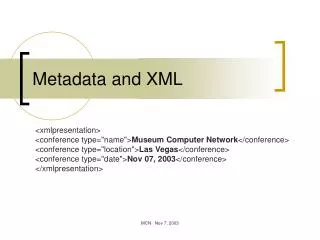
Metadata • Literally “data about data” • “a set of data that describes and gives information about other data” ― Oxford English Dictionary
Metadata • How do we encode metadata? • How do we encode metadata to support interoperability? Simple example: January 31, 2001 31 janvier 2001 2001-01-31 01-31-2001 31012001
What is the Dublin Core? • A metadata standard for describing digital resources • An initiative to create a digital “library card catalog” for the Web • Dublin Core fields: (all optional) Title Creator Subject Description Publisher Contributor Date Type Format Identifier Source Language Relation Coverage Rights
What’s a structured document? • A structured document is a document whose structure conforms to a certain set of rules • Data and metadata encoded in an interoperable manner
What is XML? • XML = eXtensible Markup Language • XML is a standard for exchanging structured data • Provides standardization at the syntactic level • Does not provide “meaning” for the tags • XML is a standard recommended by the W3C
Goals of XML • Easy to use • Easy to extend and adapt • Easy to write programs that use XML • Support a wide variety of applications • Should be human legible • Formal and concise
The Basic Rules • XML is case sensitive • All start tags must have end tags • Elements must be properly nested • XML declaration is the first statement • <?xml version="1.0"?> • Every document must contain a root element • Attribute values must have quotation marks • <item id=“33905”> • Certain characters are reserved for parsing • < = ‘<’
XML Example • <class> <name>LBSC690</name> <instructor>Jennifer Golbeck</instructor> <department>LBSC</department></class>
Benefits • Data is represented in a universal syntax • This allows any website to read the data • Makes the exchange of data easier
RSS • RSS = Really Simple Syndication or Rich Site Summary • An XML format for distributing news headlines on the Web
RSS Example <item> <title>Maryland’s Slots Commission Pressures Anne Arundel County</title> <link>http://www.newsline.umd.edu/blog/index.php/2009/ 11/12/maryland%e2%80%99s-slots-commission-pressures-anne-arundel-county/</link> <pubDate>Thu, 12 Nov 2009 23:48:41 +0000</pubDate> <dc:creator>rlorente</dc:creator> <description>Gambling in Anne Arundel County seemed so close Thursday, but yet so far away. The Video Lottery Facility Location Commission nearly voted Thursday on a motion to approve the proposal for a casino at the Arundel Mills shopping mall without zoning approval from the Anne Arundel County Council. The council has not approved a zoning plan</description> </item>
And Others… • CML – chemical Markup Lang • CellML – biological models • BSML – bioinformatic sequences • MAGE-ML – Microarray Gene Expression • XSTAR – for archaeological research • XMLMARC – MARC in XML • AML – astronomy markup language • SportsML – for sharing sports data
The next best thing since… • What’s the big deal about XML? • What does XML not do? • How do XML tags acquire meaning? • How do standards arise?
What’s wrong with the Web? • It was meant for humans, not machines • The current Web contains only data, not knowledge • From Web of data to Web of knowledge • Difficult to • Aggregate/compare data across sites • Delegate complex tasks to “agents” • Formulate complex queries involving multiple constraints • …
Web 2.0 • Tagging (“folksonomy”) • Blogging • Web services • Wikipedia
Summary • Concepts covered: • Metadata • Structured Documents • XML • Semantic Web • Ontologies