Major Mineral Groups: Silicates, Carbonates, Oxides, and Sulfides
260 likes | 283 Vues
Explore the vast world of minerals categorized into silicate, carbonate, oxide, and sulfide groups, with detailed insights into feldspar, quartz, pyroxene, mica, calcite, dolomite, hematite, magnetite, and pyrite.


Major Mineral Groups: Silicates, Carbonates, Oxides, and Sulfides
E N D
Presentation Transcript
Mineral Groups Chapter 5.4
Major Mineral Groups Silicates Carbonates Oxides and Sulfides
I Silicate Group • 90% of all minerals fall within this group • Silicon and oxygen compound with some type of metallic element • Forms a silica tetrahedron = 4 oxygen bound to 1 silicon atom • Are classified according to the way that the tetrahedra are linked together
Silicate Families • Feldspar • Quartz • Pyroxene • Mica
1. Feldspar • Most abundant family of minerals • Makes up 60% of Earth crust • All feldspars share three features • Two directions of cleavage • Hardness of 6 • Pearly luster
2 Major Groups • Feldspars are classified into two major groups • Potassium Feldspars • Sodium-calcium Feldspars
Potassium Feldspar • The most common potassium feldspar is orthoclase • Light colored – pink or salmon • Two cleavage surfaces meet at right angles • Commonly found granite
Sodium-Calcium Feldspar • Called Plagioclase Feldspar • Color ranges from white to gray • Two cleavages surface at slightly less than a right angle • One cleavage surface is marked by fine parallel lines – called striations
Feldspar Uses Rock-forming minerals Used in the manufacturing of glass and ceramics
2. Quartz Second most abundant mineral Chemical formula SiO2 Made entirely of tightly bound silica tetrahedra
Luster & Color • Glassy or greasy luster • Pure quartz is colorless • colored varieties include: rose quartz, amethyst, and smoky quartz
Fracture & Hardness • Conchoidal or irregular fracture • Hardness of 7 • Hardest common mineral
Quartz Uses • The hardness and optical properties of quartz makes it ideal for certain industrial uses • Watch movements, prisms, heat lamps, lenses, glass, and paints • Semiprecious gemstone – often worn as jewelry
3. Pyroxene • Occur widely • Cleavage surfaces meet nearly at right angles • Example: Augite • Most common • Dark in color • Ferromagnesian silicate – contains iron and magnesium
4. Mica • Soft silicates • Harness of 2.5 • Perfect cleavage • Form flat crystals that cleave in only one direction to form thin sheets or flakes • Muscovite – silvery white • Biotite – brown or black
Mica Uses • Useful in both sheets and powders • Electronic insulators • Paints • Plastics • Rubber • Roofing
Other Silicates Amphibole Minerals • Form long, needlelike crystals • Hornblende - most common • Shiny dark green, brow, or black • Hardness of 5 to 6 • Found in igneous and metamorphic rock
II Carbonates • Made of negatively charged carbonate ions bonded to positive metal ions • Each carbonate ion is made of one Carbon atom covalently bonded to three oxygen atoms • Examples: • Calcite • Dolomite
Carbonate Uses • The rocks limestone and marble consist almost entirely of carbonate minerals • Used in construction • Limestone is also used in a variety of everyday products including paper and medicine
Calcite The most common carbonate mineral Colorless or white Hardness of 3 – can be scratched with a knife Three perfect cleavages Can use an acid test to identify calcite
Dolomite Hardness of 3.5 to 4 Cleaves into rhombohedra Does not bubble with hydrochloric acid Appears as coarse or fine grains in dolomitic limestone
III Oxides and Sulfides • Minerals that have significant amounts of the element iron • Oxide – mineral consisting of a metal element combined with oxygen • Sulfide – mineral consisting of a metal element combined with sulfur
Oxide and Sulfide Uses • Used to Make • Steel • Magnets • Car parts • Medicines • Cosmetics • Plastics • Paints
Hematite Most common iron oxide Red Earthy lust Uneven fracture Red-brown streak Hardness 5-6
Magnetite Black iron oxide Attracted to magnets Hardness between 5.5 to 6.5
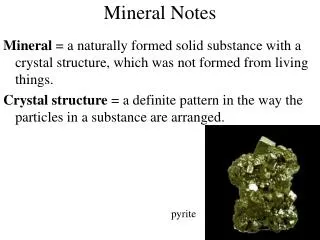
Pyrite Most common iron sulfide mineral Color ranges from pale brass to golden yellow Harness of 6 6 – 12 sided crystal Also called fool’s gold