Branding Elements and Strategies
240 likes | 275 Vues
Branding Elements and Strategies. The nature, scope, and importance of branding in product planning The various branding elements The different types of brands How to classify branding strategies.


Branding Elements and Strategies
E N D
Presentation Transcript
Branding Elementsand Strategies • The nature, scope, and importance of branding in product planning • The various branding elements • The different types of brands • How to classify branding strategies • The right name is an important part of every successful business. The name and symbols of a business or a product project the personality of the company, product, or service.
private distributor brand • generic brand • brand extension • brand licensing • mixed-brand strategy • co-branding strategy • brand • brand name • brand mark • trade name • trade character • trademark • manufacturer brand
Branding • A brand is a name, term, design, or symbol (or combinations of them) that identifies a business or organization and the products that they offer. Brands are divided into two categories: • corporate brands • product brands
Branding • Corporate brandsidentify the business and reflect quality, value, and reliability. • Example:Coca-Cola, Disney, McDonald's, and Citibank • Product brandsconnote quality and reliability for a particular product. • Example:Pepsi, Coke, Barbie, Whopper, and Big Mac
A brand name is the word, group of words, letters, or numbers of a brand that can be spoken. • Example:PT Cruiser, Mountain Dew, SnackWells • A brand mark is a symbol, design, or distinctive coloring or lettering that identifies a brand. • Example:U.S. Postal Service's eagle, Apple Computer's apple
A trade name isthe legal name under which a company or division of a corporation does business. • Example:Amex, Dell, Kellogg's, and Xerox • A trade character is a brand mark with human form or characteristics. • Example:The Jolly Green Giant, the Pillsbury Doughboy A trademark is a brand name, brand mark, trade name, trade character, or a combination of these given legal protection by the federal government and noted by the trademark symbol () or (™).
Brand names, brand marks, trade names, trade characters, and trademarks are often combined to form a firm's corporate symbol or name.
Types of Brands • Three classifications of brands are: • manufacturer brands (national or producer) • private distributor brands • generic brands
National Brands (producer brands) owned by national manufacturers • Generate the majority of sales for most categories • Examples: Hershey Foods, Whirlpool, Ford, Hilton, American Airlines, Kraft and Nestle • Internet based national brands • Amazon.com, eBay, Monster TYPES OF BRANDS
Private Distributor Brands private brands, store brands, or dealer brands • Developed and owned by wholesalers and retailers • Examples: Arizona for JC Penney, George for Wal-Mart, Villager for Kohl's TYPES OF BRANDS Both are private distributor brands from SEARS
Generic Brands Does not carry a company identity • Packaging usually features a description of the product • Example: Pancake Mix, Paper Towels • Usually sold in supermarkets and discount stores • Often sold for 30 – 50% less than name brands TYPES OF BRANDS
Brand Extension • Brand Licensing • Mixed Brands • Co-Branding BRAND STRATEGIES
A branding strategy that uses an existing brand name to promote a new or improved product in a company’s product line BRAND EXTENTION
Some companies allow other organizations to use their brand, brand mark, or trade character through brand licensing Licensing company gets a fee (royalty) in return for authorization Has licensing agreements with BRAND LICENSING
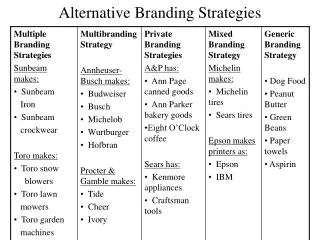
Offer a combination of manufacturer, private distributor, and generic brands MIXED BRANDS Their own National Brand tires Private Brand for SEARS
Combines one or more brands in the manufacture of a product or in the delivery of a service Co-BRANDING
Rebranding • Rebranding - a change to the brand name, logo, or image of a product or company • brand owner revisits the brand with the purpose of updating or revising Re-Branding
Branding is… …a promise to deliver value.
That value comes from: Trust & familiarity Who the company collaborates with Source: south.unc.edu Source: technabob.com
Your personal brand works the same way How do you build people’s trust in you? Who do you collaborate with? Source: www.jisc.ac.uk Source: cheezburger.com
Effective brands understand their strengths The hacker The hustler The designer • Builds things • Comes up with unexpected solutions to problems • Will bend rules if it’s valuable to do so • Sells things • Enjoys presentations, debates and public speaking • Excels at coming up with arguments • Designs things • Shows empathy for the customer experience • Is highly resilient and open to other people’s ideas