The Great Pyramid of King Khufu: A Monument of Ancient Egypt
370 likes | 504 Vues
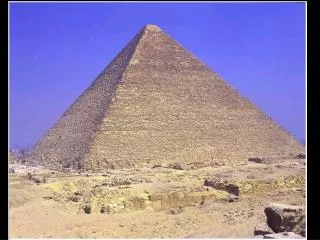
The Great Pyramid of King Khufu, also known as Cheops, represents a pinnacle in ancient Egyptian architecture. Built around 2589-2566 B.C., it originally stood at an impressive 481 feet tall before settling at 449 feet. Covering 13 acres, this monumental structure was crafted from limestone and granite, showcasing the ingenuity of Egyptian builders. The pyramid served as a tomb and reflects the cultural significance of the era, linked to the afterlife as depicted in texts like the "Book of the Dead."


The Great Pyramid of King Khufu: A Monument of Ancient Egypt
E N D
Presentation Transcript
2900 to 900 B.C. Week 3
Pyramid of King Khufu King Khufu, who is also known by the greek name “Cheops,” was the father of pyramid building at Giza.
Dates Built: c. 2589-2566 B.C.
Height: Originally 481 feet (146.5 m) tall, but now only 449 feet (137 m).
Base: 13 square acres, 568,500 square feet, or 7 city blocks.
Section from the “Book of the Dead” of Nany, Third Intermediate Period, Dynasty 21, reigns of Psensennes I–II, ca. 1040–945 B.C. Egyptian; Western Thebes Painted and inscribed papyrus; H. of illustrated section 13 3/4 in. (34.9 cm)
Statue of Memi and Sabu, Old Kingdom, Dynasty 4, ca. 2575–2465 B.C. Egyptian; Probably from Giza Painted limestone; H. 24 3/8 in. (62 cm) Rogers Fund, 1948 (48.111)
Statuette of Amun, Third Intermediate Period, Dynasty 22, ca. 945–715 B.C. Egyptian Gold; H. 6 7/8 in. (17.5 cm)