Influence of Prior Activity on Residual Limb Volume and Shape: Results from Transtibial Limb Loss Individuals
This study examines how prior activity affects the shape of plaster casts taken of transtibial residual limbs. The findings show that ordering of trials had a significant influence on the mean radial difference between two shapes. Practitioners should consider prior activity and doffing history when casting limbs for socket design and prosthetic fitting.

Influence of Prior Activity on Residual Limb Volume and Shape: Results from Transtibial Limb Loss Individuals
E N D
Presentation Transcript
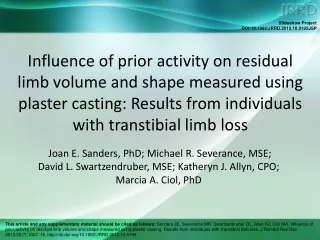
Influence of prior activity on residual limb volume and shape measured using plaster casting: Results from individuals with transtibial limb loss Joan E. Sanders, PhD; Michael R. Severance, MSE; David L. Swartzendruber, MSE; Katheryn J. Allyn, CPO; Marcia A. Ciol, PhD
Aim • Determine whether prior activity affected shape of plaster cast taken of transtibial residual limb. • Relevance • If practitioner does not carefully plan measurements to account for previous activity, changes in volume and shape might not be measured correctly, leading to false interpretation of clinical measurements.
Method • 24 participants with transtibial limb loss. • Plaster casts were taken twice in 1 day. • Two trials: • PDI-5s: 5 s between doffing and casting. • PDI-20m: 20 min between doffing and casting. • Ordering of trials was randomized.
Results • Mean radial difference between PDI-20m and PDI-5s: • 0.34 mm when PDI-5s conducted first. • 0.02 mm when PDI-20m conducted first. • Ordering of trials had statistically significant influence on mean radial difference between the two shapes.
Conclusion • Result shows that prior activity influenced residual limb cast shape. • Practitioners should be mindful of prior activity and doffing history when casting individual’s limb for socket design and prosthetic fitting.