Download
1 / 8
80 likes | 196 Vues
This summary explores the significant role of emotions in conflicts and negotiations. It highlights how emotions can both fuel and resolve conflicts, emphasizing the importance of positive emotions for constructive outcomes. Key points include the influence of emotions on parties' perspectives, the impact of emotional needs on conflict dynamics, and strategies for effectively managing emotions in negotiations. By recognizing and using emotions, individuals can enhance communication, foster cooperation, and achieve better resolutions in disputes.

E N D
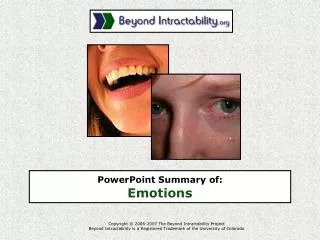
Copyright © 2006-2007 The Beyond Intractability ProjectBeyond Intractability is a Registered Trademark of the University of Colorado PowerPoint Summary of: Emotions
Slide 2: • Emotions and Conflict • Emotions are both a cause and a • result of conflict • Positive emotions are key to • conflict resolution • Conflicts are fueled by emotional • needs (love, closure…) PowerPoint Summary of: Emotions
Slide 3: Emotions and Conflict II Emotion can overcome logic --sometimes emotional issues become more important than substantive issues PowerPoint Summary of: Emotions
Slide 4: • Emotions and Conflict II • Emotion frames conflict – • shaping parties’ view of: • Relationships • Fairness • Relative power • Relative status PowerPoint Summary of: Emotions
Slide 5: • Emotion in Negotiation • Emotions can influence negotiations and • mediations either positively or • negatively • Positive emotions foster: • Problem solving • Creativity • Respect for others’ perspectives • Improved cognitive ability • Negative emotions foster: • Inaccurate judgments • Lessened concern for the other parties’ preferences • Neglect of one’s own instrumental goals PowerPoint Summary of: Emotions
Slide 6: • Emotion in Negotiation II • Emotions can inform us of our • adversaries’: • Commitment • Sincerity • Needs • Values PowerPoint Summary of: Emotions
Slide 7: • Recognizing and Using Emotions • To use emotion effectively: • Acknowledge --emotions in yourself and others • Determine --their source • Manage --you own negative emotions PowerPoint Summary of: Emotions
PowerPoint Summary of: Emotions • Slide 8: • Recognizing and Using • Emotions • To use emotion effectively: • Allow --the other side to express their feelings without dismissing them • Empathize --with the other • Reframe -- your positions and interests in a less emotionally-threatening manner