Exploring Plant Systems: Texas Bluebonnets and Photosynthesis
This unit focuses on the fascinating systems within plants, specifically highlighting transport, reproduction, and response mechanisms. We delve into the Texas Bluebonnet, our state flower, and explore key vocabulary such as gravitropism, hydrotropism, and photosynthesis. Students will learn about specialized plant cells and tissues, including roots, stems, and leaves, and how these structures play vital roles in plant functions. Understanding these processes and terms will enhance your appreciation for the living world of plants!

Exploring Plant Systems: Texas Bluebonnets and Photosynthesis
E N D
Presentation Transcript
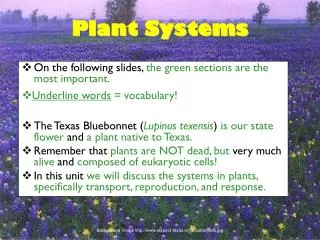
Background Image http://www.respect-texas.org/bluebonnets.jpg • On the following slides, the green sections are the most important. • Underline words = vocabulary! • The Texas Bluebonnet (Lupinustexensis) is our state flower and a plant native to Texas. • Remember that plants are NOT dead, but very much alive and composed of eukaryotic cells! • In this unit we will discuss the systems in plants, specifically transport, reproduction, and response. Plant Systems
Vocab List: • Copy this list (1st page for our new unit ). • As we move through the unit, update the page # of these vocabulary words to help you prepare and study! • Gravitropism • Hydrotropism • Nastic response • Phloem • Phototropism • Pistil • Stamen • Stigma • Stoma • Thigmotropism • Xylem
Review of Plant Cells • Plants are multicellular eukaryotes w/ cell walls made of cellulose. • Plants are autotrophs that carryout photosynthesis to obtain energy. • To carry out cellular functions, plants need: • Sunlight • Water • CO2 • Minerals http://www.terrebonneonline.com/plantcell1.jpg
Review of Photosynthesis 6CO2 + 6H20 + LIGHT C6H1206 + 602 (Carbon dioxide) (water) (glucose) (oxygen) • Photosynthesis – the process by which plants convert light energy and carbon dioxide into sugars as a food source for the plant. http://s2.hubimg.com/u/701793_f520.jpg
Cell Specialization • Plants have cell specialization (different cell types perform specific functions). • EX Root cells, stem cells, and flower petal cells all have specific functions (jobs) that they carry out for the plant. http://www.bio.txstate.edu/~wetlands/Kids_and_Teens_Page/parts%20of%20a%20plant.jpg
Specialized Tissues - Leaves • Leaf is the organ wheremost photosynthesis, and transpiration [evaporation from plants] occurs. • Remember, photosynthesis is used by plants to create energy. • Through the leaf run veinstransport water, sugars, and minerals to the plant cells. http://www.ecomagic.org/fruition/leaves-1.jpg
Specialized Tissues - Stems • Stems are specialized cells that support leaves to hold them up to sunandtransport water, sugars, and nutrients through the plant. • Some stems are also modified for sugar [glucose] storage areas. http://www.arboretum.fullerton.edu/grow/images/plant_organs.jpg
Specialized Tissues - Roots • Rootsareunderground organs that absorb water and minerals necessary for transport in the plant andanchor [hold] the plant in the soil. • Theyhelp to prevent soil erosion. • taproot – (ex: carrot) single large central root • fibrous root – (ex: grasses) clump of short threadlike divisions http://www.kidsgardening.com/onlinecourse/Diagrams/c5/c5-1root.gif
Transport Tissues • Just like in animals, vascular [vein] tissue is the transport system for the plant. • Xylem – transports water (L for liquid) in stacked cells to form tube like drinking straws; movement is UP from roots to leaves • Phloem – transports sugar/food; movement can be up and down http://3.bp.blogspot.com/_b8o0_bDa4QI/RsKvBY5ZufI/AAAAAAAAAF0/BmCafNOYe6A/s400/xylem1%5B1%5D.gif
Reproductive Tissues - Flowers • Flowersare a reproductive organ (but not all plants have flowers). • They havemale and female parts. • pollination – transporting pollen (sperm) from the male to female parts (ovule) • fertilization – union of sperm with egg (creates a development ofa plant embryo [seed] which grows into a mature plant). http://www.prairiefrontier.com/pages/families/flwrparts.jpg
Flower Parts • Male • Stamen – consist of the anther (produces pollen) and filament (supports anther) • Pollen – contains sperm • Female • Pistil – consist of the stigma (where pollen lands), style (connects stigma to ovary) and the ovule (develops into the fruit) • Ovule – develops into an egg, eventually becomes the seeds when fertilized • Non-sexual • Petals – colored parts, attract pollinators (EX bees) • Sepals – green parts, protect flower parts
Flower Parts Cont. http://www.microscopy-uk.org.uk/mag/artoct08/bj-peru.html
Reproductive Tissues - Seeds • Seed Plants form seeds (a plant embryo surrounded by a food supply) in order to reproduce. • Seeds are encased in a protective covering called a seed coat. • EX fleshy fruit such as strawberries, apple, tomato, peach, cucumber • EX dry fruit such as walnuts and acorns http://asm.wku.edu/courses/Biol115/Wyatt/Plants/seeds/seed.gif http://urbanext.illinois.edu/gpe/images_rev/seed-pics.jpg
Seedless Reproduction • Seedless plants do not form hard seeds (EX mosses and ferns) and therefore these plants MUST have water in order for the sperm to swim to the egg. http://biology.uwsp.edu/courses/plantid/cp-seedless/images/cp-seedless-images-sm/013-d.lg.sm.jpg http://www.kidsgardening.com/onlinecourse/Diagrams/c10/c10-4fern.gif
Response • Just like animals, plants respond to changes in their environments (called tropism). • There are four main types of tropisms: • Gravitropism/Geotropism= response in plants thatmake it grow either with the pull of gravity or against it • Hydrotropism = response in plants that bends it towards water • Phototropism = response in plants that bends it towards light • Thigmotropism = response in plants that bends it around an object (EX a vine wrapping around an arbor)
Response Cont. http://withfriendship.com/images/h/38808/Tropism-picture.gif
Response Cont. • Another type of response, specifically to changes in pressure, is called a nastic response. • The most common example is the infamous Venus flytrap which closes its leaf when the plant senses an insect through changes in cell pressure. • North Carolina’s Nastic Slideshow http://www.justvenusflytraps.com/images/homepageimage.jpg
Conclusion • Plantsprovide consumers with oxygen to breathe, food, shelter, as well as cleaning the air and water for the planet. This photo was taken in the Scottish Highlands. • Just like animals, plants are active responders within various environments to survive and thrive. • Their use and importance is numerous; humans use plants with healing properties in medical treatments. PhotographbyLuis del Río