Myoelectrically Driven Functional Electrical Stimulation for Upper Limb Motor Recovery Post-Stroke
This pilot study evaluates the feasibility and effectiveness of Myoelectrically Controlled Functional Electrical Stimulation (MeCFES) for poststroke upper limb rehabilitation. Results show significant improvement in the experimental group, suggesting MeCFES could be a valuable tool in stroke rehab. Larger studies are needed for definitive conclusions.

Myoelectrically Driven Functional Electrical Stimulation for Upper Limb Motor Recovery Post-Stroke
E N D
Presentation Transcript
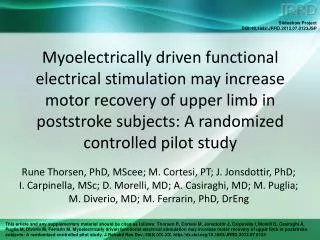
Myoelectrically driven functional electrical stimulation may increase motor recovery of upper limb in poststroke subjects: A randomized controlled pilot study Rune Thorsen, PhD, MScee; M. Cortesi, PT; J. Jonsdottir, PhD; I. Carpinella, MSc; D. Morelli, MD; A. Casiraghi, MD; M. Puglia; M. Diverio, MD; M. Ferrarin, PhD, DrEng
Aim • Assess feasibility and effectiveness of myoelectrically controlled functional electrical stimulation (MeCFES) for poststroke rehabilitation of upper limb. • Relevance • Most subjects experiencing cerebrovascular accident will have reduced upper-limb function. • In stroke rehabilitation, therapist may work on residual movements.
Method • 11 poststroke hemiparetic subjects with residual proximal arm control but impaired volitional opening of paretic hand. • Experimental group • MeCFES: Myoelectric activity from wrist and finger extensors controlled stimulation of same muscles. • 3-5 treatments sessions/week (25 sessions total). • Control group
Results • Experimental group: • Significant and clinically important improvement in Action Research Arm Test score, confirmed by Individually Prioritized Problem Assessment self-evaluation score. • Improvement maintained at follow-up. • Control group: • No significant improvement.
Conclusion • Reduced sample size, together with confounding factors (e.g., spontaneous recovery) calls for larger studies to draw definite conclusions. • However, large and persistent treatment effects indicate that MeCFES could be important clinical tool for stroke rehabilitation.