Design and Testing of an Air Handler System for the Submillimeter Array Project
This project focuses on the design, construction, and testing of an Air Handler System for the Submillimeter Array (SMA) at the University of Hawaii. The system features 8 movable antennas that detect light colors at wavelengths of 0.3 to 1.7 mm. The Air Handler maintains a constant temperature using two valves for cold air and recirculation. The report highlights the design requirements, fabrication, testing data, and analysis, emphasizing the successful operation of the model for future upgrades and testing purposes. Acknowledgments are given to mentors and staff involved.

Design and Testing of an Air Handler System for the Submillimeter Array Project
E N D
Presentation Transcript
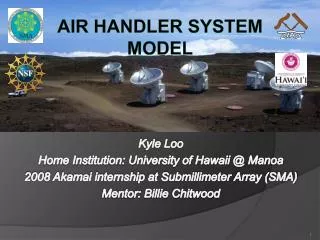
Kyle Loo Home Institution: University of Hawaii @ Manoa 2008 Akamai internship at Submillimeter Array (SMA) Mentor: Billie Chitwood Air Handler System Model
SMA Project Description Background Design Construction Test Conclusion Acknowledgments Outline
Submillimeter Array • 8 movable antennas • Detects light colors • 0.3 – 1.7 mm Wavelengths • Air Handler • Constant Temperature • 2 Valves • Cold & Recirculation • 4 of the 8 antennas are upgraded currently
Design and Build smaller Air Handler and cabin for testing purposes Design Requirements: Accurately simulate Air Handler Use main components Be operated by original software Purpose: Use as a test model Debug Saves time Project Description :
First Design: Second Design: Preliminary Designs:
Fabrication • Air Handler/Mixing Box • Two 4 inch Intakes holes • 2.5 inch Rear exhaust which enters into the Cabin
Heater Installation Temperature sensors Solid State Relay Heater
Modification of Intake Valves • 4 inch dryer vent • Enlarge one axle hole • Damper motor turns 3/5 inch round bar • Notched at one end to hold valve in place when operating
Shop Vac Modification • Universal Motor • Able to use voltage regulator to control speed • 4 inch adapter on the exhaust side to be able to match with 4 inch intake valves • Temperature and Humidity Sensors
Test/Data Analysis • Stable after one and half hours
Conclusion • Air Handler Model • Used for testing purposes • Useful for future hardware and software upgrades • Great Experience • Design • Fabricate • Test
Acknowledgments • I would like to thank the following: • Mentor – Billie Chitwood • John Cheng, Kevin O’Cconnell, and Mac Cooper. • All of the SMA staff for using their tools, material, and facilities. • Lynne Raschke, Lisa Hunter, Sarah Anderson, Hilary O’Bryan, Scott Seagroves and the rest of the CfAO staff . • All the Akamai Interns Funding provided through the Center for Adaptive Optics, a National Science Foundation Science and Technology Center (STC), AST-987683