Download
1 / 14
140 likes | 251 Vues
This set of lessons focuses on identifying and proving the properties of quadrilaterals, including parallelograms, rhombuses, rectangles, squares, trapezoids, and kites. Students will learn to determine the specific type of quadrilateral based on properties such as side lengths, angles, and diagonals. The assignment encourages applying theorems to real-world problems and enhances understanding through practical exercises and progress tracking. Students will explore the definitions, properties, and conditions necessary to classify and understand these geometric figures.

E N D
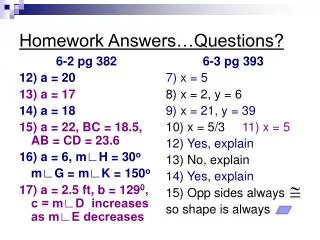
6-2 pg 382 12) a = 20 13) a = 17 14) a = 18 15) a = 22, BC = 18.5, AB = CD = 23.6 16) a = 6, m∟H = 30o m∟G = m∟K = 150o 17) a = 2.5 ft, b = 1290, c = m∟D increases as m∟E decreases 6-3 pg 393 7)x = 5 8) x = 2, y = 6 9) x = 21, y = 39 10) x = 5/311) x = 5 12) Yes, explain 13) No, explain 14) Yes, explain 15) Opp sides always so shape is always Homework Answers…Questions?
6-5 Conditions for Rectangles, Rhombuses, and Squares Learning Goal: determine if a parallelogram is a rhombus, rectangle, or square
What do you remember? List all the quadrilaterals that have: A) all sides congruent B) opposite sides congruent C) diagonals perpendicular D) diagonals congruent E) consecutive angles supplementary F) all angles are right angles G) diagonals bisect the opposite angles
To prove whether or not a is a rhombus, rectangle or square: A) Prove the conditions in the definitions (4 congruent sides or 4 right angles) B) Prove diagonals a perpendicular (rhombus) C) Prove one diagonal bisects a pair of opposite angles (rhombus) D) Prove the diagonals are congruent (rectangle)
EX: What is the most precise name for this quadrilateral? A) B) Rhombus – a diagonal bisects the opposite angles Square – diagonals are congruent (rectangle) and are ┴ (rhombus)
C) Rhombus D) Rectangle EX: For what value of x is ABCD the given parallelogram?
Assignment: Due Tuesday Heading: 6-5 pg 407 #1-7 * Write which theorem you used as explanation. **add assignment to your progress tracker
6-6 Trapezoids and Kites Learning Goal: Correctly identify and use properties of trapezoids and kites
Notes: Toolkit! • What quadrilaterals don’t have both pairs of opposite sides parallel and congruent? • Add the definitions and theorems from section 6-6 to your toolkit.
EX: Calculate the measure of each angle of the isosceles trapezoid.
EX: For kite KLMN, calculate the measures of the numbered angles.
Assignment: due Tuesday Heading: 6-6 pg 413 # 6-9 and pg 417 # 7-10 * Write the theorems you use **Due Tuesday: 6-4, 6-5, 6-6 homework; be ready for quiz!