Unit Conversions Factor Label Method
Understanding unit conversions through dimensional analysis is essential in science and engineering. Measurements must be expressed in appropriate units, and often require conversion. This method involves multiplying a known quantity by a conversion factor, which, derived from equalities, cancels unwanted units leaving only the desired one. For effective conversions, write down the incorrect measurement, set up fractions with desired units, and fill in numbers accordingly. Remember to cancel units and round to the correct significant figures. Learn to efficiently convert time, distance, and speed with practice.

Unit Conversions Factor Label Method
E N D
Presentation Transcript
Dimensional AnalysisFactor Label Method • Measurements that are made of some aspect of the universe must have a quantity and a unit • Many times, values are not measured in the unit that we want • We have to do some math to get the numbers in the form that we desire
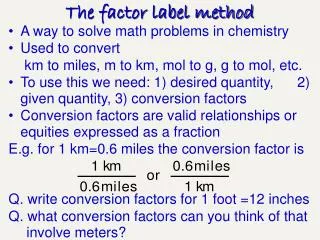
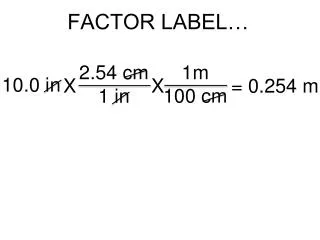
Dimensional AnalysisFactor Label Method • To convert a measurement from one unit to another, multiply the known quantity and unit(s) by a conversion factor
Conversion Factors • The chosen conversion factor cancels all units except those desired for the answer • Conversion Factors come from equalities • Equalities yield two conversion factors: • 1 ft = 12 in
Conversion FactorsChoosing the Correct Conversion Factor • Example: Convert 179,800 s to minutes
Conversion FactorsChoosing the Correct Conversion Factor • Write Measurement with wrong units • Write “Multiplication Sign, Fraction Bar” • Write the unit that you want to cancel on the bottom of the fraction. Write the desired unit on the top of the fraction • Fill in the fraction with the numbers that make the numerator & denominator of the fraction equivalent • Cancel Units → PLUG & CHUG!!! → Round to the proper number of SF
Conversion FactorsMultiple Steps • Each conversion factor should cancel out a unit from the previous measurement (or conversion factor) • Convert 179800 s to days
Conversion FactorsMultiple Steps with Complex Units • Each conversion factor should cancel out a unit from the previous measurement (or conversion factor) • Convert 65.0 mi/hr to m/s • 1 mi = 1.6 km