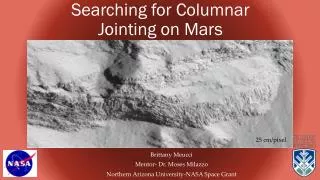
Searching for Columnar Jointing on Mars
80 likes | 182 Vues
This study investigates the phenomenon of columnar jointing on Mars using high-resolution imaging from the HiRISE camera aboard the Mars Reconnaissance Orbiter (MRO). Columnar jointing is typically formed by volcanic processes, and this research analyzes over 30,000 images of crater walls and lava-water interactions. Findings suggest implications for ancient life, emphasizing the presence of fresh water lake deposits. The research is supported by NASA's Space Grant program and conducted at Northern Arizona University under the mentorship of Dr. Moses Milazzo.


Searching for Columnar Jointing on Mars
E N D
Presentation Transcript
Searching for Columnar Jointing on Mars Brittany Meucci Mentor- Dr. Moses Milazzo Northern Arizona University-NASA Space Grant 25 cm/pixel
What is Columnar Jointing? North Ninepin Island, Hong Kong
High Resolution Imaging Science Experiment (HiRISE) On board the MRO ~1 % canvassed 30,000 + photos 370-400 km above Mars 1 m objects
Where is it? - Impact processes - Volcanic processes - Crater walls 25 cm/pixel 25 cm/pixel
Importance -Previous life -Fresh water lake deposits
Conclusions Lava-water interaction Discovered by MRO’s HiRISE ~1% canvassed Found only in impact processes Life on Mars
AcknowledgementsNASA Space Grant programNorthern Arizona UniversityDr. Barlow and Mrs. StigmonAnd a special thanks to my mentor, Dr. Milazzo Questions?