Understanding the Excretory System: Kidney Function and Urine Production
Dive into the fascinating world of the excretory system and its primary component, the kidneys. Discover intriguing facts about kidney size, location, and blood filtration capacity. Learn how kidneys maintain water and salt balance, eliminate nitrogen waste, and help regulate blood pressure. Explore the intricate structure of nephrons and their key roles in urine formation. This overview provides essential insights for your next biology test and highlights the importance of studying the excretory system.


Understanding the Excretory System: Kidney Function and Urine Production
E N D
Presentation Transcript
Excretory system Points to ponder about pee Or Test next class and if you don’t study you’re in urine
Interesting Facts: • 1.The kidneys are about the size of a small bar of soap.
2. The kidneys are behind the liver and under the last two ribs for protection. 3. They are surrounded by fat.
4. ¼ of your entire blood supply goes through the kidneys every minute. 5. In 24 hours it filters 150 - 180 litres of blood. 6. In 24 hours you only make 1 - 1.8 L of Urine.
Main Job of the Kidneys: • Maintain water and salt balance. • Eliminate Nitrogen wastes. • Helps maintain blood pressure.
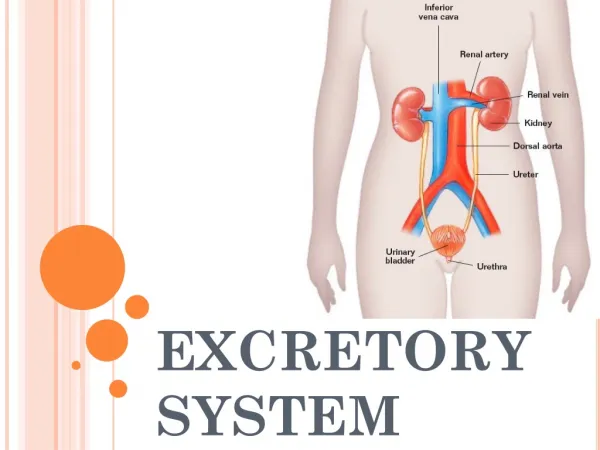
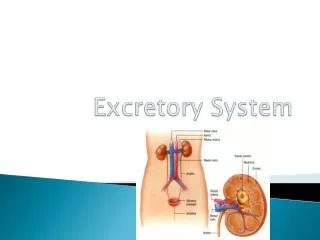
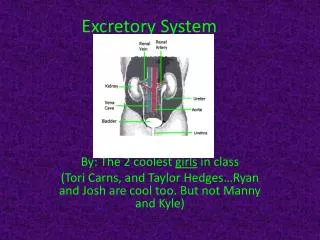
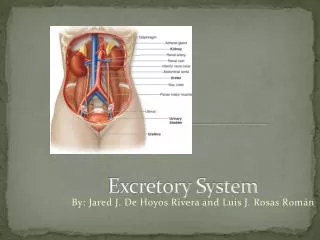
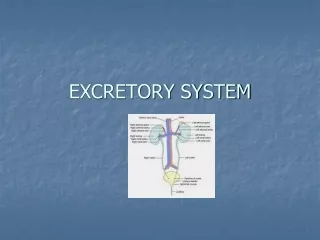
Kidney Structure Function Tough outer “skin” that protects the kidneys contains most of the Nephron(Bowman’s capsule and twisted tubules Filters the blood Inside the cortex. Contains the Loop of Henle. Reabsorbs water and salt. Carries urine to the Calix. Collects urine and carries it away to the Ureter 2 tubes that drain the kidneys into the Bladder A muscular sac that stores urine and stimulates the urge to pee when it contains ½ to 1 litre of urine. A Tube that empties the bladder, to eliminate wastes from the body. • Renal Capsule • Cortex • Medulla • Calix and Renal Pelvis • Ureter • Bladder • Urethra
Nephron • Each kidney has 1 million. • They filter the blood, • Then secrete poison, drugs and H+ ions for pH balance, • Allow reabsorption the water and salt by the blood • Making urine. Contains Urea from digesting proteins • Uric Acid from digesting nucleic acids. • Creatininemuscle metabolism
Nephron Structure Function Under high pressure from the arteries the filter out the plasma. (Squeeze the fluid out of the blood through the tiny holes in the capillaries). This is where glucose, aminoacids, water and salt are reabsorbed into the blood stream.Secretes poisons, drugs and H+ ions for pH control. Reabsorbs water and salt NaCl Carries urine to the Ureters. More water and salt is reabsorbed into the blood here. • GlomerularCapillaries (Near) (Far) • Proximal/ distal Convoluted renal tubule (Twisted) • Loop of Henle • Collecting ducts
Total Body Water Volume40 liters Intracellular Extracellular 15 liters 20% of body weight Interstitial fluid 12 Liters Blood plasma 3 Liters Water inside the cell 25 liters 40% of body weight
Daily Input /output2500 mls Daily average input Daily average output 100 mL Feces 200 mL sweat 700 mLLungs and skin 1500 mL Urine • 250 mL Metabolism • 750 mL Foods • 1500 mL Beverages