Download
1 / 7
70 likes | 203 Vues
The fear of communism in the United States predates its entry into World War II, originating with the House Un-American Activities Committee (HUAC) in 1938 and intensified during the Cold War. The Smith Act of 1940 criminalized advocating for the overthrow of the government, upheld in the Dennis case. Truman’s Loyalty Program (1947) launched investigations into government employees' affiliations, while the Hiss case (1948) and the McCarthy hearings spotlighted anti-communist fervor, fueled by notorious figures like Sen. McCarthy. The Rosenbergs' conviction for espionage exemplified the paranoia, highlighting a turbulent period of civil rights violations.

E N D
The cold war at home May 1, 2014 Note Packet C
The fear of communist began before the US entered WW2 • House Un-American Activities Committee(HUAC, 1938) • Investigative unit for communist activity • Hollywood movie industry
The fear of communist began before the US entered WW2 • J. Edgar Hoover & FBI criticized for violating civil rights • The Smith Act (1940) • Made it illegal for anyone to advocatethe overthrowing of US gov’t • Dennis v. US (1951) – upheld act • Watkins v. US & Yates v. US (1957) – weakened act
The fear of communist began before the US entered WW2 • The Loyalty Program (1947) • Truman ordered a Loyalty Review Board • Conducted security acts on gov’t employees • The Hiss Case (1948) • Former FDR advisor accused & foundguilty of being a communist spy • Proved a real threat in US
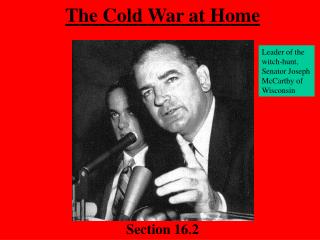
McCarthyism in the US (1950s) • Senor McCarthy began a 4 year hunt for communists • Based on a list of state dept. employees believed to be communists • Making bold accusations w/o evidence
McCarthyism in the US (1950s) • The Rosenberg Case (1950) • Ethel & Julius charged w/ giving atomic secrets to Soviets during WW2 • Convicted of espionage, sentenced to death
McCarthyism in the US (1950s) • McCarthy televised investigations • Public witnessed bullying tactics • Public support faded & anticommunist attitudes lingered