Download
1 / 6
60 likes | 170 Vues
Lean supply chains have revolutionized the business landscape, enabling greater responsiveness and efficiency. By fostering information sharing among supply chain partners and adopting lean principles—such as pull systems and level production schedules—companies can adapt swiftly to changing customer demands. In contrast to traditional arms-length relationships, long-term partnerships are key to success. As enterprises spend less on supply chain management, integrating key processes and addressing hidden costs can unlock significant competitive advantages. Explore how modern advancements are reshaping business ecosystems today.

E N D
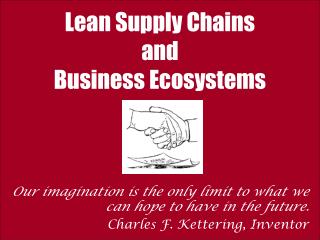
Lean Supply ChainsandBusiness Ecosystems Our imagination is the only limit to what we can hope to have in the future. Charles F. Kettering, Inventor
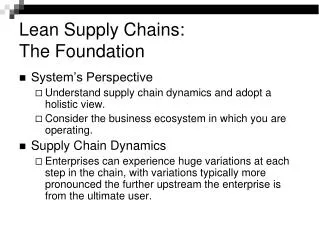
A Lean Supply Chain Second tier supplier Supplier manufacturer Warehouse Distribution Center Retailer Consumer • Under different ownership • Lean • Short cycle time • Level Production Schedule • Pull System • Such as vision was unattainable for many businesses in the past.
Has anything changed? The whole business landscape has changed • IT information sharing for supply chain members. • Manufacturing methods quantum reduction in cycle time. • Advances in logistics quantum reductions in the storage and transit times. • Long-term partnership set aside traditional arms-length relationships. • A lean SC integrates all the key processes and partners. Adapts to changing customer needs and still deliver products quickly.
A Lean Supply Chain • On average, enterprises spent about 11% (about 1 trillion dollars) of revenue on SCM, yet best-in-class enterprises about 4.5%. These figures do not take into account • Hidden costs or, in Dr. Deming's terms, “unknown and unknowable.” • Less quantifiable benefits such as increased market share for supply chains that respond faster to customer needs.
A Lean Supply Chain • On average, enterprises spent about 11% (about 1 trillion dollars) of revenue on SCM, yet best-in-class enterprises about 4.5%. These figures do not take into account • Hidden costs or, in Dr. Deming's terms, “unknown and unknowable.” • Less quantifiable benefits such as increased market share for supply chains that respond faster to customer needs.