The Mongol Rule and the Rise of the Russian Empire (1480-1795)
This chapter explores the impact of Mongol rule on Russia, highlighting local administration by Russians, the decline in literacy and cultural life, and the rise of Ivan III of Moscow against the Mongols, leading to a centralized government. The reign of Ivan IV (1547-1584) is examined, showcasing his paranoia and brutal actions against perceived threats. The transition to the Romanov Dynasty and the Time of Troubles are outlined, along with significant leaders like Peter the Great and Catherine the Great, who expanded the empire and advanced Westernization despite maintaining autocracy and serfdom.
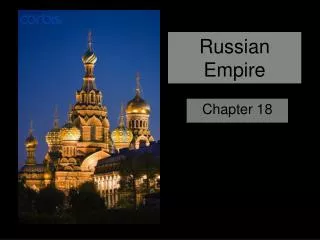

The Mongol Rule and the Rise of the Russian Empire (1480-1795)
E N D
Presentation Transcript
Russian Empire Chapter 18
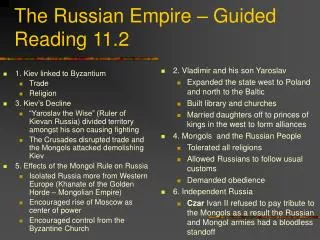
Mongol Rule • Local administration in the hands of the Russians • Reduced cultural and economic life • Literacy declined • All agricultural
1480: Creation of a large independent state • Ivan III, prince of Moscow, rose up against the Mongols • Strong central government • Head of Orthodox Church
1547-1584: Ivan the IV reign • Ivan the IV was a bit paranoid and killed boyars he believed to be working against his throne. • Beat daughter-in-law (was pregnant) • Attacked his son (when confronted) • Crowned Tsar of all Russians • Known to torture animals • Death led to time of troubles
Romanov Dynasty • Boyars chose Michael as czar • Order and stopped invaders • Alexis • Expanded role of czar • Abolished assembly of the nobles • Wanted to cleanse the church of changesthose that resisted were exiled to Siberia “Old Believers”
Peter the GreatRomanov Dynasty • 1682-1725 • Western technology • Forced and rapid modernization • No representative government—bureaucrats were from outside autocracy • Focuses on military—army & navy • Secret police • Western clothes & style; shave beards • Moved capital to St Petersburg • Added the Baltic—success against Sweden
Catherine the GreatRomanov Dynasty • 1762-1795 • Expanded the empire East to Alaska • Institution of serfdom expanded • 1649 law tied serfs to landlords • Strong centralized government was more important than Enlightenment ideas • Patron of western arts and architecture
Russian serfdom • Free peasants fell into debt and forced to become serfs on large estates • Used to make nobility happy and control the masses • 1649 Act—serfs are born into the status, cannot get out of serfdom, could be bought and sold, punished by masters BUT not literally slaves
Life of a serf • Illiterate • Poor • Pay high taxes • Owed labor service to their landlords—agriculture, mining or manufacture • Grain exported to the West • No real motivation for efficient agriculture practices
Expansion • Added Siberia • Cossacks were sent to occupy new land • Nobles & bureaucrats received land grants
What is Westernization? • Absolute monarchy with bureaucracy • Systemized law code and tax system • Peasants bear the brunt • Metallurgy and mining • Increased education in science and math • Upper-class women’s lives improved • All classes resisted
1450-1750 • Russia has contact with the West • Only a few big cities; 95% rural • No strong merchant or commercial class • Long-lasting multinational empire • Autocrats bring Westernization and expansionism

![Russian and Chinese Empire-Building [1450-1750]](https://cdn1.slideserve.com/2317048/russian-and-chinese-empire-building-1450-1750-dt.jpg)
![Russian and Chinese Empire-Building [1450-1750]](https://cdn1.slideserve.com/2814246/russian-and-chinese-empire-building-1450-1750-dt.jpg)