Download
1 / 12
120 likes | 255 Vues
This article explores the evolution of landfills from ancient waste disposal methods to modern sanitary landfills that minimize environmental risks. It highlights critical statistics about waste generation in the U.S., the classification of different landfill types—Municipal Solid Waste, Industrial Waste, and Construction & Demolition debris—and the environmental challenges posed by landfills. The article also discusses measures to redesign landfills and reduce waste generation to improve sustainability in waste management.

E N D
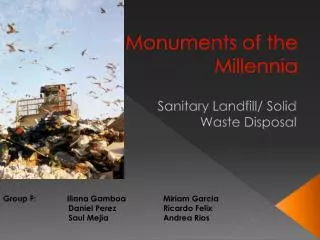
Monuments of the Millennia Sanitary Landfill/ Solid Waste Disposal Group F: IlianaGamboa Miriam Garcia Daniel Perez Ricardo Felix Saul Mejia Andrea Rios
Facts • Americans generate trash at an astonishing rate of 4.6 pounds per day per person. [4] • 32.5 percent, was either recycled or composted. [4]
Landfills in History • In around 3000 BC in the Cretan capital, Knossos, waste was placed in large pits and covered with dirt at various levels.[1] • In the1920’s the first official landfill was created in England.[2] • In US, the first government established sanitary landfills were built in the 1930s.[2]
What is a landfill? • It is a way of disposing waste. • A secure landfill is a carefully engineered depression in the ground into which wastes are put. • The aim is to avoid any hydraulic connection between the wastes and the surrounding environment, particularly groundwater.[3]
Types of landfills • Municipal Solid Waste Landfill • Industrial Waste Landfills • Construction & Demolition Debris Landfills
Municipal Solid Waste Landfill (MFWLs) • Municipal solid waste landfills receive household waste. • MSWLFs can also receive non-hazardous sludge, industrial solid waste, and construction and demolition debris.[4]
Industrial Waste Landfill • Items such as organic chemicals, inorganic chemicals, steel, plastics and resin manufacturing are allowed in IWL. • American industrial facilities generate and dispose of approximately 7.6 billion tons of industrial solid waste each year • After an ISW landfill is closed, the facility is maintained and monitored for 30 year.[6]
C&D Debris Landfill • C&D materials often contain bulky, heavy materials, such as concrete, wood, metals, glass, and salvaged building components. • Reducing and recycling C&D materials conserves landfill space, reduces the environmental impact of producing new materials • Household garbage, electronic equipment, fluorescent bulbs, liquid waste and utility poles cannot be disposed of in a C&D debris landfill.[7]
Environmental Problems • Water emissions • Atmospheric emissions • Landfill fires • Decomposition • Landfill leakage [2]
Improvements • Redesigning landfills is a main solution to prevent contamination of the environment. • One of the most important ways to improve the landfills is to reduce the amount of garbage produced by the average American home.[2]
Sources 1.http://www.wasteonline.org.uk/resources/InformationSheets/HistoryofWaste.htm#1 2. http://www.nrel.gov/docs/legosti/fy98/25035.pdf (pg. 114 - 122) 3. http://en.wikipedia.org/wiki/Waste_management 4. http://www.epa.gov/waste/nonhaz/municipal/landfill.htm 5. http://greenliving.lovetoknow.com/Environmental_Problems:_Landfills 6. http://www.epa.state.oh.us/dsiwm/pages/indupro.aspx 7. http://www.scdhec.gov/environment/lwm/recycle/pubs/c&d_debris.pdf Article: “World Trends in Municipal Solid Waste Management” by S. Sakaia, S. E. Sawellb, A. J. Chandlerc, et all.