Understanding Moral Development: Self-Control and Its Behavioral Manifestations
490 likes | 627 Vues
This chapter explores moral development in children, focusing on self-control and its relationship with societal expectations. It details how children learn to resist temptation and delay gratification through age-related strategies. Parenting styles play a crucial role in teaching self-control, distinguishing between overly strict and permissive approaches. The text also discusses the evolution of prosocial behaviors, the roots of aggression, and moral reasoning stages according to Kohlberg. Understanding these concepts is essential for fostering healthy moral development in children and ensuring they grow into socially competent adults.


Understanding Moral Development: Self-Control and Its Behavioral Manifestations
E N D
Presentation Transcript
Chapter 14 – Moral Development • Self-Control - behavioral manifestation of morality
Learning morality - society’s goal: resist temptation - delay gratification
Development of self-control - age 1 learn limits - by 2 inhibit own impulses - by 3 use techniques
4 Learning mechanisms 1. General parenting style Control + caring -> kids learn selfcontrol vs. too strict or too laissez-faire -> kids don’t learn to control selves
Modeling - learn to inhibit self by watching model who verbalizes rationale - kids as models: later better at restraint
3. Reinforcement - rewards for alternative behaviors
Punishment - best = mild punishment & rationale - sometimes rationale alone is enough -> internal attributions Problems - resentment, coercion, attention for bad behavior
4 Self-Control Methods 1. Freud’s imagery = create image of desired object - but reduces self-control
2. Distraction - focus on alternative activity 3. Self-instruction - talking self through the impulse
4. Create “moral” self-concept - convince children that they are “good” via “dispositional praise” - self-concept directs future behavior
Consequences of Self-Control If delay gratification at 4: - boys at 11 = better impulse control, attention span, & behavior - girls at 11 = more socially competent - both at 15-18 = better self-control, reasoning, SAT scores
Prosocial Behavior Development • Toddlers - beginning to help others - limited by cognitive skills
Preschool/Elementary - sharing, helping - motivated by rewards & authority - later growth of prosocial behavior without rewards
Adolescents/Adults - concern for fairness, helping others - behavior based on principles
Skills needed Perspective-taking - more prosocial if understand others’ feelings - lack of egocentrism
Empathy - feeling what another feels
Moral Reasoning - belief that one should behave a certain way - preschoolers don’t use fairness - by school age, simple view of fairness - later appreciate complexity of fairness
Influences on prosocial behavior 1. Personal Responsibility - when we feel responsible, we are more likely to help Personal responsibility decreased by: - diffusion of responsibility - authority figures
2. Mood - more prosocial if happy 3. Cost to self - more prosocial if no cost to self
4. Culture - more altruism in nonindustrialized nations - collectivist vs. individualistic societies
Percentages of children above altruism mean • Nonindustrialized Kenya 100 Mexico 73 Philippines 63
Industrialized Okinawa 29 India 25 US 8
Aggression Origins of Aggression 1. Biological/instinctual - Freud - Lorenz
2. Cognitive/Intentional - aggression is goal-driven Hostile goal = intent to harm Instrumental goal = gain own ends
Development of Aggression Infants & young toddlers (< 1.5 yrs) - aggression without intent to harm
Preschoolers (2-5) - intimidate to gain own ends - rise in instrumental aggression
a. 2-3 - more physical retaliation - most aggression is instrumental b. 3-5 - less physical aggression - more verbal aggression - increasing hostile aggression
Elementary School (6-11) - react with aggression to provocation
Stability of Aggression very stable - from toddlerhood - for boys and girls - boys are more aggressive
Sources of Aggression 1. Frustration - frustration-aggression hypothesis
2. Parents Punishment - teach physical aggression Parental style - model lack of concern for others - do not monitor/supervise - use physical discipline more
Sex Differences - males more physically aggressive worldwide - males are targets of aggression - testosterone + socialization - girls: “relational” aggression
4. Culture - some societies are more violent
5. Media - Bandura’s Bobo doll - “good guys” rewarded for violence
General findings: - consistent link between TV violence & child aggression - risks: learning to behave violently desensitization to violence fearfulness - perpetrators unpunished - few consequences for victim
6. Individual Differences - minority of very aggressive kids a. expectations b. domination of others c. biased cognitions - assume hostile intent • Sum: many possible contributors
Controlling Aggression 1. Freud’s catharsis - venting anger to decrease it - does not work
2. Eliminate reinforcement a. incompatible response technique - ignore mild aggression & reinforce good behavior b. time out - for serious aggression - removes attention for aggression - does not model aggression - helps child gain self-control
3. Model & coach - teach nonaggressive conflict resolution • Teach empathy - train awareness of others’ feelings
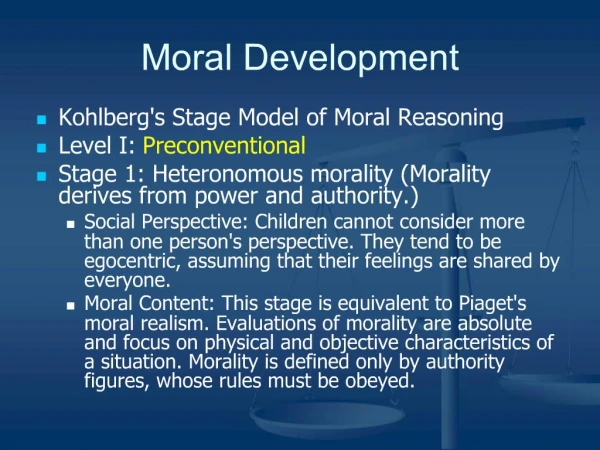
Moral Reasoning Dilemma = competing demands for justice • Kohlberg’s Stages 1. Preconventional Level - moral judgments are based on physical consequences, authority/power, own needs & desires
2. Conventional Level - reasoning based on conforming to social norms, doing what is “right”/duty, wanting the approval of others
3. Postconventional Level - based on universal, abstract principles - fairness/justice
Judy is 12 years old. Her mother promised that she could go to a special rock concert.
Support for Kohlberg 1. Correlation between age & level of moral reasoning 2. Sequence of stages 3. Relation between moral reasoning & behavior
Criticisms of Kohlberg • Highest principle may differ by society • Highest stage reached • Male vs. female morality
Gilligan’s Theory • Morality = care & responsibility in relationships - integration of rights & responsibility
3 stages • Self - concern solely with own needs (selfish) • Others - other’s needs at expense of own (selfless) • Both - considering own & others’ needs
Boys and girls show both justice and care morals • Conclusion: Not one morality (justice), but possibly many
1. Preconventional Level - consequences, authority/power, needs & desires 2. Conventional Level - social norms, “right”/duty, approval 3. Postconventional Level - based on universal, abstract principles