Download
1 / 5
0 likes | 2 Vues
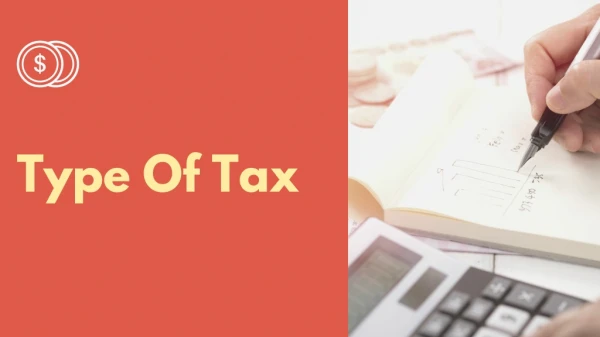
Automation and AI streamline calculations, error checks, and routine data processing, but complex financial scenarios, strategic planning, and personalized guidance still rely on human expertise. Tax professionals leveraging technology can focus on high-value advisory roles while ensuring compliance and accuracy. Hybrid models that combine AI efficiency with human judgment deliver faster, smarter, and more reliable tax services. The future of taxation thrives on collaboration, not replacement. Learn how our experts handle complex taxes: https://rajkishan.cpa/tax-preparation/

E N D
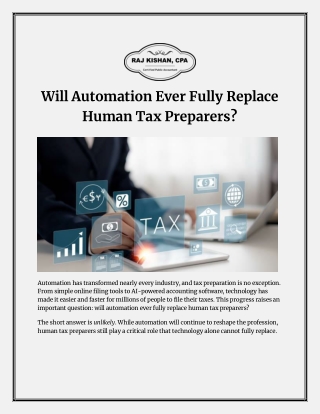
Will Automation Ever Fully Replace Human Tax Preparers? Automation has transformed nearly every industry, and tax preparation is no exception. From simple online filing tools to AI-powered accounting software, technology has made it easier and faster for millions of people to file their taxes. This progress raises an important question: will automation ever fully replace human tax preparers? The short answer is unlikely. While automation will continue to reshape the profession, human tax preparers still play a critical role that technology alone cannot fully replace.
How Automation Has Changed Tax Preparation Over the past two decades, tax software has evolved dramatically. Today’s tools can: ●Automatically calculate taxes ●Detect basic errors ●Import financial data from employers and banks ●Suggest deductions and credits ●File returns electronically within minutes For individuals with simple tax situations—such as a single job, no investments, and standard deductions—automation works extremely well. These systems are efficient, affordable, and increasingly accurate. As a result, many routine tax returns no longer require human assistance. What Automation Does Well Automation excels in areas that are: ●Rule-based– Tax calculations follow strict formulas. ●Repetitive– Similar returns can be processed at scale. ●Data-heavy– Software can quickly process large amounts of numerical data. ●Standardized– Common tax scenarios fit neatly into pre-built systems. For basic compliance, automation reduces human error, saves time, and lowers costs. This has already reduced demand for human preparers in straightforward cases.
Where Automation Falls Short Despite its strengths, automation has clear limitations. 1. Complex Financial Situations Taxpayers with businesses, multiple income streams, investments, international assets, or major life changes often face complex decisions. These situations require interpretation, judgment, and strategic thinking—areas where humans still outperform machines. 2. Tax Strategy and Planning Software focuses on filing accurately, not necessarily on long-term planning. Human tax professionals help clients: ●Plan for future tax years ●Choose optimal business structures ●Make strategic financial decisions ●Minimize risk while staying compliant This kind of personalized advice goes beyond automated checklists. 3. Changing Laws and Gray Areas Tax laws change frequently and are often open to interpretation. Human preparers stay updated on new regulations, court rulings, and nuanced guidance that software may lag behind in implementing or interpreting correctly. 4. Human Trust and Accountability When something goes wrong—such as an audit or notice from tax authorities—people want a real person to explain the issue, defend decisions, and provide reassurance. Accountability and trust remain deeply human qualities.
The Role of AI in the Future of Tax Preparation Artificial intelligence will undoubtedly play a bigger role going forward. AI can: ●Identify patterns and anomalies ●Improve accuracy in complex returns ●Provide smarter prompts and recommendations ●Assist preparers with research and documentation However, rather than replacing humans, AI is more likely to augment them. Tax professionals who embrace technology can work faster, serve more clients, and focus on higher-value advisory work instead of manual data entry. A Shift, Not a Disappearance The tax profession is not disappearing—it’s evolving. ●Routine tax filing will continue to be automated. ●Human tax preparers will shift toward advisory, consulting, and complex compliance roles. ●Hybrid models (human + AI) will become the standard. This mirrors what has happened in other fields like medicine, law, and engineering, where technology enhances human expertise instead of eliminating it. Final Thoughts Automation will continue to change how taxes are prepared, but it is unlikely to fully replace human tax preparers. Taxes are not just about numbers—they involve judgment, strategy, trust, and an understanding of individual circumstances. The future of tax preparation isn’t human versus automation. It’s human with automation. Those who adapt, learn new tools, and focus on providing value beyond basic filing—especially through reliable tax preparation services—will remain essential in an increasingly automated world.
Contact Us ●Email: raj@rajkishan.cpa ●Phone: 7813335544 ●Website: www.rajkishan.cpa





![[PDF] Free Download After Ever Happy By Anna Todd](https://cdn4.slideserve.com/8250834/slide1-dt.jpg)
![[PDF] Free Download Best I've Ever Had By Abbi Glines](https://cdn4.slideserve.com/8375834/slide1-dt.jpg)