Models for on-line control of batch polymerization processes
160 likes | 308 Vues
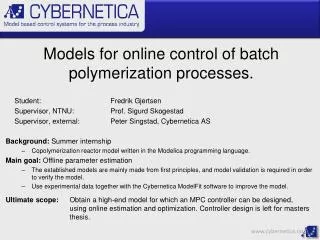
This research focuses on developing a model-based predictive control (MPC) system for semi-batch free-radical emulsion copolymerization processes. The study is led by Fredrik Gjertsen under the supervision of Prof. Sigurd Skogestad and Peter Singstad. It provides a comprehensive overview of the modeling, estimation, and control of the process. Key components include parameter estimation using experimental data, implementation of state estimation algorithms such as Kalman filtering, and analysis of conversion and molecular weight distribution. Suggestions for future work include extending the setup to continuous reactors.


Models for on-line control of batch polymerization processes
E N D
Presentation Transcript
Models for on-line controlof batch polymerizationprocesses State and parameter estimation for a semi-batch free-radicalemulsioncopolymerizationprocess Student: Fredrik Gjertsen Supervisor, NTNU: Prof. Sigurd Skogestad Supervisor, external: Peter Singstad, Cybernetica AS Trondheim, 13. desember 2013
Agenda • Motivation and overview: MPC • Model description • The need for estimation • Results from off-line parameter estimation • Conclusions from thework • Looking forward: A proposal for an extension to thework
Typicaldevelopmentprocess (In my case: Approximatelyoneyear)
Components of an MPC implementation • Initially: A processofinterest – Free-radicalemulsioncopolymerization • Step 1: Acquire a processmodel • Step 2: Verify and improvetheprocessmodelthrough parameter fitting • Ultimate goal: A completepackageincluding all thenecessarycomponents
Model description • Free-radicalemulsioncopolymerization • Monomers: Styrene, Butyl acrylate • Multi-component, multi-phase, reactivechemical system • Semi-batch reactorsetup • The model is formulated in lab-scale • The modelwasformulatedusingtheModelicaprogramminglanguage and implementedusingtheDymolasoftware. • Parameter fitting wasperformedusingtheCyberneticaModelFitsoftware.
Estimator algorithms • States and parameters ofthemodel is onlyknownwith a certainaccuracy • Off-line parameter fitting prior to on-line implementation • On-line state and parameter estimation (filtering) • The estimator is a keycomponent in themodel-basedcontrollerimplementation • H∞-methods, MovingHorizon Estimator, etc. • Kalman Filter estimator has beenchosen • Extended to apply for nonlinear systems
Strategy for parameter fitting • Off-line parameter estimation is done usingexperimental data • Typicaloptimization problem: fk: Model output at time k ym,k: Measurement at time k θ: The entirecollectionof parameters φ: Parameters chosen for optimization • Similar to themethodofleastsquares. • lsqcurvefitin MATLAB
Results – Reactortemperature (Initial behavior)
Results – Conversion of monomer (Initial behavior)
Results – Conversion of monomer (With optimallyfitted parameters)
Results – Molecularweightdistribution (Initial behavior)
Results– Molecularweightdistribution (With optimallyfitted parameters)
Conclusions • Some parameters have beenadjusted to improvethemodel • Factorsgoverningthechemicalreaction rates • Factorsgoverningterminationofgrowing polymer chains • Factorsgoverning heat transfer remainuntouched • Demand for computationalpower is high • Maybetoohigh? • Includesimplifications for on-line implementation? • The establishedformulations for on-line estimationcan be applied in the on-line controllerimplementation
Suggestions for furtherwork • Complete the MPC setup for a semi-batch case • Tune estimator basedonprojectwork • Design and tune controlleralgorithm • Extendtheestablishedwork to includecontinuousreactor cases • «Smart-scale» tubularreactors • This willrequire more modelingwork, but most ofthetheory is reapplicable • Design and tune both estimator and controller, usingexperimental data for tubularreactors