Understanding Electric Fields, Gauss's Law, and Induced Dipoles in Conductors and Dielectrics
This comprehensive overview explores the concepts of electric fields, Gauss's Law, and the behavior of induced dipoles in various materials. It highlights the significance of uniform electric fields and the symmetrical properties of conductors and dielectrics. The relationship between electric fields and induced dipoles in atoms such as helium and sulfur is discussed, alongside the principles of magnetic fields and their continuous loops as per Ampere's Law. Key formulas and principles are presented to aid in understanding these fundamental concepts in electrostatics and magnetism.

Understanding Electric Fields, Gauss's Law, and Induced Dipoles in Conductors and Dielectrics
E N D
Presentation Transcript
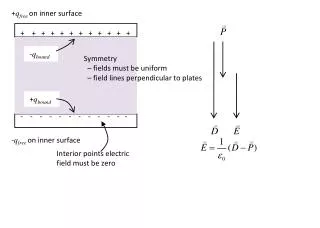
+qfreeon inner surface + + + + + + + + + + + + -qbound Symmetry – fields must be uniform – field lines perpendicular to plates +qbound - - - - - - - - - - - - -qfreeon inner surface Interior points electric field must be zero
+ + + + + conductor - - - dielectric Gauss’s Law
dielectric constant frequency
+ + + + + + + + + + + + - - - - - - - - - - - - V = 0
iron core BFe HFe gap region Bgap Hgap i coil windings Bair Hair
. . . . . . . . 3 4 X X X X X X Current i out of page Circulation loop: square of length L 1 2 Current i into page Cross-section through electromagnet
thickness t width L q = - e area A electrons are the charge carriers in copper
+ - + - + - + - + - + - + - + - + - + - + - + - + - + - + - + -
+ + + + + + + + + dy + + + + + + + + + F - - - - - - - - - -q +q
+ + + + + + + + + V r - - - - - - - - - x L-x C = CA + CB
Induced dipole moment – helium atom +2e +2e -e -e -e -e Zero electric field – helium atom symmetric zero dipole moment A B effectively charge +2e at A and -2e at B dipole moment p = 2ed
Induced dipole moment – sulfur atom +16e +16e -8e -8e -8e -8e Zero electric field – helium atom symmetric zero dipole moment A B effectively charge +16e at A and -16e at B dipole moment p = 16ed
Er E P r2 r + (d/2)cos r1 r – (d/2)cos r (d/2)cos +q -q
dA +f + + + + + + + + + -b +b - - - - - - - - - -f
-q +q
S +f -b O r +b -f
- - - S d r + Pcos + + The area of the shaded ring between and + d is equal to
+Ze +Ze d a a d << a
F F +Q d F - Q
+ p E U 0 - p E π π/2 0
Po T
1 slope = 1/3 0 10 pE/kT
Gaussian surface S conducting sphere q air a r non-conducting liquid Symmetry field lines must be radial
conducting sphere q Eairt air Eliquidt non-conducting liquid Symmetry Eairt = Eliquidt Eair = Eliquid = E
field lines of E field lines of D
- + + - - + + shift in atoms due to ionic nature of bond induced dipoles due to shift in electron cloud rotation orientation of polar molecules
6 5 4 S N HFe Hair Circulation loop: square side L 2 1 3
Cylindrical Gaussian surface Gauss’s Law for magnetism B-field lines – form continuous loops
N pole Bound surface currents (right hand screw rule)
un-magnetized piece of iron Bar magnet bought near un-magnetized piece of iron N N N Bar magnet will attract the iron that was initially un-magnetized north pole attracts south pole
Cu ramp Fe ramp plastic ramp N N N
Circulation loop for circulation integration used in applying Ampere’s Law N N Hair Hiron
if if d