Hemophilia
120 likes | 416 Vues
Hemophilia. By: Lauren Donnangelo. Symptoms. Excessive bleeding after surgery, trauma, or injury Sudden or unexplained bleeding Bruised and swollen muscles or joints Deformed joints Bloody urine or stool Severe bruising Frequent nosebleeds


Hemophilia
E N D
Presentation Transcript
Hemophilia By: Lauren Donnangelo
Symptoms • Excessive bleeding after surgery, trauma, or injury • Sudden or unexplained bleeding • Bruised and swollen muscles or joints • Deformed joints • Bloody urine or stool • Severe bruising • Frequent nosebleeds • Difficulty breathing due to bleeding in the throat • Extensive pain • Dizziness, fatigue, or headaches due to bleeding of the brain sheenasgenetics.tripod.com
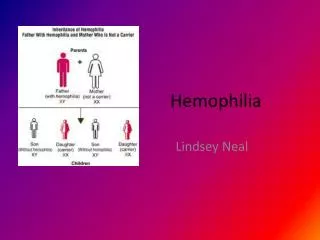
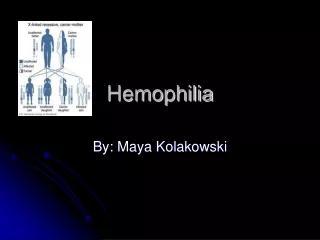
Genetic Cause • Hemophilia is a recessive sex-linked disorder. • The mutated gene that accounts for hemophilia is located on the X chromosome. • A mutation in the F8 gene causes Hemophilia A, and a mutation in the F9 gene causes Hemophilia B. • These mutations result in an absence of several proteins required for blood clotting. singularityhub.com
Treatment • There is no cure for hemophilia and no way to prevent it. However, patients can receive injections of donated, synthetic, or recombinant forms of plasma. • Human Factor VII concentrate: plasma-derived Factor VII is made from donor plasma • Recombinant Factor VIII concentrate: recombinant plasma containing albumin • Porcine Factor VIII concentrate • Prothrombin Complex Concentrate: contains prothrombin, Factor X and Factor IX • Coagulation Factor IX concentrate treats Hemophilia B • Cryoprecipitate: contains Factor VIII and fibrinogen • Synthetic plasma, DDAVP • High amounts of estrogen or progesterone www.pathguy.com
Tests and Screenings • Blood tests can be used analyze the amount of coagulation factors present (or absent) in the blood, as well as clotting rate. • Chronic Villus Sampling (CVS) or Amniocentesis can determine pre-natal hemophilia. • Physical examination • Family history/pedigree analysis www.sillyjokes.co.uk
Percentage of Population • One in every 10,000 males (approximately 0.01%) has Hemophilia A, and it is extremely rare for a woman to have Hemophilia A. • One in every 60,000 males (approximately 0.002%) has Hemophilia B, and it is extremely rare for a woman to have Hemophilia B. • Hemophilia occurs in all world populations, regardless of race/ethnicity or environment/region. www.humanillnesses.com
Societal Issues • Hemophilia is culturally accepted in most societies, and there are many support groups, fundraisers, and educational programs for hemophiliacs and their families. • In the United States, there are organizations such as the National Hemophilia Foundation and the Hemophilia Federation of America. • There is also a World Federation of Hemophilia. www.hemophiliavillage.com
Bibliography • Shah, Ira. “Hemophilia.” Pediatric Oncall. 22 Feb. 2009. <http://www.pediatriconcall.com/fordoctor/diseasesandcondition/hemophilia.asp#> • “Hemophilia.” Genetics Home Reference. 22 Feb. 2009. <http://ghr.nlm.nih.gov/condition=hemophilia> • “Understanding Hemophilia- the Basics.” WebMD. 22 Feb. 2009. <http://www.webmd.com/a-to-z-guides/understanding-hemophilia-basics> • “What Is Hemophilia, Hemophilia FAQ’s.” Hemophilia Village. 22 Feb. 2009. <http://www.hemophiliavillage.com/about_hemophilia.html> • “Learn About Hemophilia.” Salsa Challenge. 22 Feb. 2009. <http://www.salsachallenge.com/about-hemophilia/hemophilia.aspx>