Download
1 / 7
70 likes | 178 Vues
Development and Energy in Africa project aims to evaluate impacts of energy interventions on development and poverty alleviation. The project includes establishing an Assessment Framework, engaging with stakeholders, conducting case studies, and refining information on development impact. Its common approach involves structured impact assessment of energy interventions. The project has completed various stages and is working towards finalizing the Assessment Framework and disseminating results for wider stakeholder engagement.

E N D
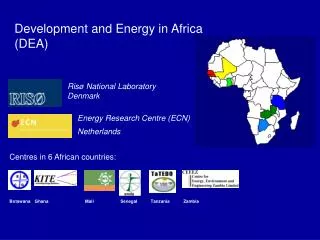
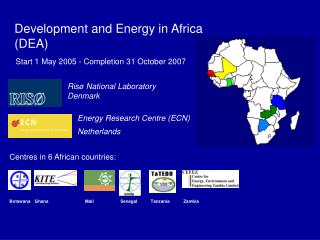
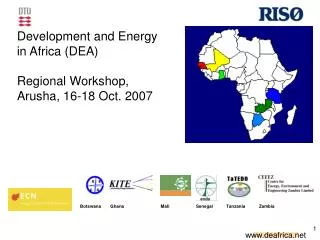
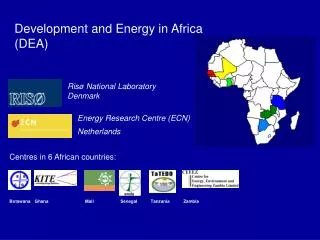
Development and Energy in Africa (DEA) Risø National Laboratory Denmark Energy Research Centre (ECN) Netherlands Centres in 6 African countries: Botswana Ghana Mali Senegal Tanzania Zambia
Development and Energy in Africa (DEA) Objectives: • to establish and apply an Assessment Framework for evaluating development and poverty alleviation impacts of energy interventions • to engage in a dialogue with energy policy makers and other stakeholders on the basis of the framework, with a view to incorporating these issues in energy policy. completed in progress Stakeholder needs Assessment Framework + Toolbox + Selection of case studies Catalogue of 42 existing projects 6 Case Studies Refinement Information on Development Impact Literature Review Improved design of future interventions (?)
complex energy intervention Common approach – The ASSESSMENT FRAMEWORK input A step by step approach to carrying out an impact assessement of a given energy intervention common approach output outcome • conceptualisation • organising principle • systematic approach • disentanglement • structure • thinking aid impact indicators systematic description of an energy intervention and its consequences
From 4-level causal diagram to assessment tables:example solar ESCO in Zambia Elements Indicators Units Source Method Provision of electricity service • Inputs: • provision of • electricity • service established ESCO ESCOs ESCOs • desk • study • Outputs: • access to • electricity • employment • total SHS • installed • jobs • SHS • no. jobs • SHS • no. jobs • interviews • interviews access to electricity employment within ESCO evening study • Outcomes: • use of electricity • lighting fuel • business hours • evening study • appliances • fuel costs • av. b. hrs • school • study/night • number • $ • hrs • hrs • number • $ • hrs • hrs • survey • interview • survey • focus • group lighting fuel consumption business hours use of electricity • Impacts: • income • educational • gender • income • sch. perf. • decision- • making • roles • $ • grades • h/h • $ • grades • h/h • survey • interview • focus • group gender relations income educational and social activities
Status late 2006 • WP2 Literature Review: work in progress, completion by Dec. 2006 • WP3 Catalogue: completed • WP4 Consultations: 1st Nat. Workshops held Sept. – Oct. 2005 • stakeholder requirements reported • WP5 Methodology 4-level causal chain based on M&EED group • guideline manual in preparation • WP6 Case Studies: 6 studies completed and reported • 2nd National workshops held • positive response from stakeholders • website: www.deafrica.net
WP5: Assessment Framework finalise Guideline Document WP6: Case Studies write synthesis document WP7: Refinement of methodology analyse case studies and stakeholder response hold 3rd project meeting Feb. 2007 to finalise methodology WP8: Dissemination prepare popular material on AF and case studies prepare for “All Africa Seminar” – Sept-Oct 2007, Arusha, TZ seek co-funding for Seminar to invite more African stakeholders Main tasks for next 6 months – Nov 06 to April 07
Challenges • Empirical identification and attribution of impacts to energy interventions • many complex linkages between input and impact • lack of baselines • prepare operational guidelines based on developed methodology tested through case studies • Presenting case study results to national multi-sector stakeholders • generalising the specific results to general development impacts of energy interventions • influencing policy makers so that development impacts of energy interventions are taken more into account in project planningg and policy • Demonstrating and encouraging the use of the Assessment Framework through stakeholder training workshops • Presenting the methodology to broader “All-Africa” audience • organise final workshop in Arusha • liaise with other COOPENER projects • attract extra funding to broaden participation