Summary Pulling it All Together
This training highlights essential tools and strategies to enhance teamwork and overcome barriers to team effectiveness. Attendees will learn to apply methods like the Two-Challenge Rule, SBAR, and Feedback techniques in real-life situations. By focusing on shared mental models, adaptability, and mutual trust, participants will be equipped to boost team performance and patient safety. Overcoming challenges such as hierarchy, lack of information, and communication issues will be a key focus, ensuring that each member contributes to unit success.

Summary Pulling it All Together
E N D
Presentation Transcript
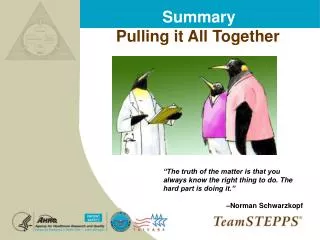
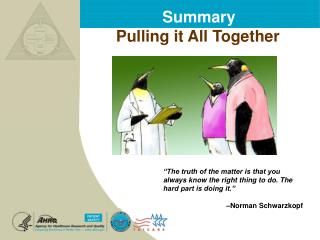
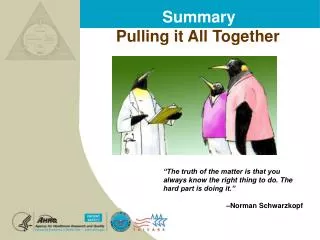
Summary Pulling it All Together “The truth of the matter is that you always know the right thing to do. The hard part is doing it.” –Norman Schwarzkopf
Objectives • Discuss how to use the tools and strategies presented in this training • Demonstrate how to appropriately apply the tools and strategies to real-life situations • Practice using tools and strategies for overcoming barriers to team effectiveness
Barriers to Team Effectiveness TOOLS and STRATEGIES Brief Huddle Debrief STEP Cross Monitoring Feedback Advocacy and Assertion Two-Challenge Rule CUS DESC Script Collaboration SBAR Call-Out Check-Back Handoff OUTCOMES • Shared Mental Model • Adaptability • Team Orientation • Mutual Trust • Team Performance • Patient Safety!! BARRIERS • Inconsistency in Team Membership • Lack of Time • Lack of Information Sharing • Hierarchy • Defensiveness • Conventional Thinking • Complacency • Varying Communication Styles • Conflict • Lack of Coordination and Follow-Up with Co-Workers • Distractions • Fatigue • Workload • Misinterpretation of Cues • Lack of Role Clarity
Identifying Opportunities to Use TeamSTEPPS Tools and Strategies
Summary In the preceding section, we learned that teamwork strategies and tools— • Are available to both team members and leaders • Can be categorized according to the specific barriers to team effectiveness in a given situation • Can all be applied to most situations because they complement one another
Action Planning “To improve teamwork in your unit, what can you commit to focusing on?” “The achievements of an organization are the results of the combined effort of each individual.” –Vince Lombardi