Resolving Vectors
This chapter covers fundamental concepts of vectors in the same plane, including how to calculate the resulting motion of objects moving in the same or opposite directions. It provides examples, such as determining Jim's speed relative to a stationary observer and calculating the displacement of a car using the Pythagorean theorem. Key concepts include adding vectors graphically and using proper techniques to find resultant vectors. This chapter is essential for grasping the basics of vector resolution and addition.

Resolving Vectors
E N D
Presentation Transcript
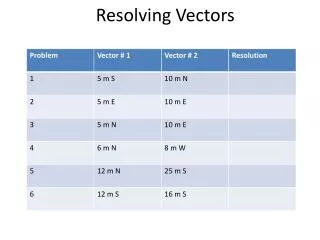
Resolving Vectors Chapter 4
Example 1 • Jim Jimson is riding the DART train. The train is traveling at 4 m/s past the station. As the train passes the station, Jim gets up and walks towards the rear (heh, heh) of the car at 1 m/s. How fast does Jim appear to be moving relative to an observer outside the train?
Vectors at right angles to each other? • Use R2 = A2 + B2= • A and B are… • R stands for resultant (the combination of A and B)
Example 2 • A car is driven 125 km due west, then 65 km due south. What is the magnitude of it’s displacement?
What the...??? • Start by drawing a picture!
125 km 65 km
Since these vectors are at right angles, we can use Pythagorean’s Theorem to solve for this one…
R2 = 1252 + 652 • R2 = 19,850 (we don’t want R2, we want R) • R = 140.8 km
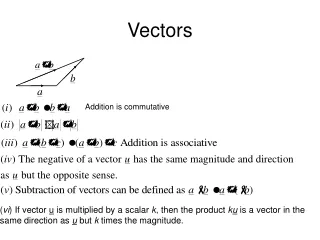
Graphically adding vectors? • Keep these things in mind: • Vectors are always added head to tail • Add the vectors in the specified order • Keep you vectors sized appropriately
Example 3 • Graphically add the following vectors: A to B to D 5 m C 7m B A 5 m 6 m D
5 m 7m 6 m