Understanding Work, Energy, and Challenges in Physics
Explore the concepts of work, potential energy, kinetic energy, and power in physics. Learn to calculate forces, energies, and velocities. Engage in challenge problems to test your knowledge.

Understanding Work, Energy, and Challenges in Physics
E N D
Presentation Transcript
Potential and Kinetic Energy
Please review the presentation and do challenge problems at the end
Work Review • Work is done when a force is exerted over a distance • Which is work? • When you drive into a wall and smash your fender • A man walking at a steady pace carrying a briefcase • When you spend an hour in a futile effort to move a large boulder • Why? • W = F X d • 1 joule of Work=1 newton of Force X 1 meter of Distance
Challenge • A 50-Pound crate is pushed across the floor by a 20-pound horizontal force. Aside from the pushing force and gravity, there is also a 50-pound force exerted upward on the crate and a 10-pound frictional force. • Construct a free body diagram • Which of these forces does no work? • Which does positive work? • Which does negative work?
Working Against Gravity • How much work do you do when you lift a 12-kilogram suitcase 0.75 meters off the ground? • What to consider • Calculate the force needed to lift first • What is the equation for force? What is the unit? • (F = m X g) • What is the equation for work? What is the unit? • (W = F X d)
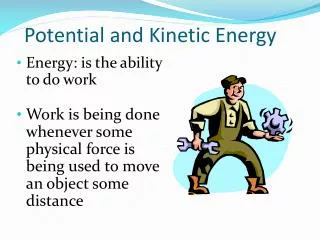
Energy/ Power Review • Energy is the ability to do work • Joules, Power X Time • If a system is capable of exerting a force over a distance, then it possess energy • Power is defined as the rate at which work is done (or energy that is expended) • Watts, Work/Time = Energy/ Time • 1 Watt of power = 1 Joule of Energy/ 1 second of TIme • Is expending energy the same thing as doing work?
Kinetic Energy • The energy of motion • Two Factors govern the amount of K energy in an object • Kinetic energy is proportional to mass • If you double the mass, you double the kinetic energy • Kinetic energy increases as the square of its velocity • If you double the speed, you increase the kinetic energy 4 times • Mathematically, kinetic energy equals the mass of the moving object times the square of that objects velocity, multiplied by the constant ½ • KE (in joules) = ½ X mass (in kg) X (velocity (in m/s/s) • KE = ½ mv²
Potential Energy • Contains the potential to do work (motion) • Gravitational Potential Energy of any object equals its weight (the force of gravity exerted on the object) times its height above the ground. • Gravitational potential in joules = Mass (kg) x g (m/s/s) x height (meters) • PE = mgh
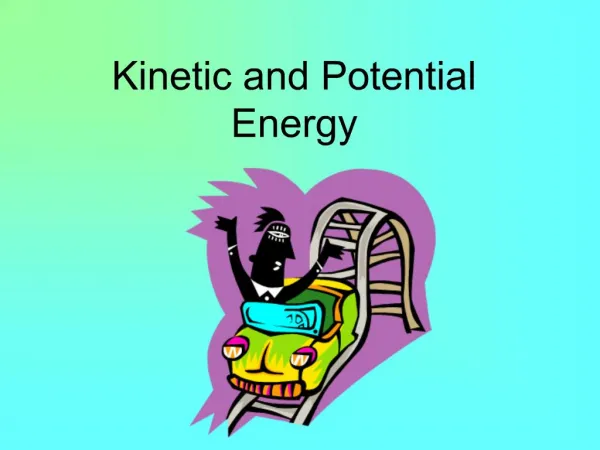
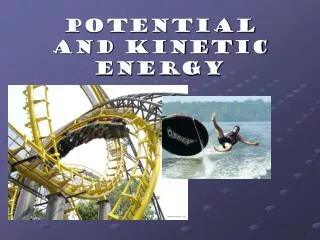
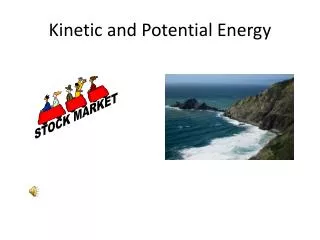
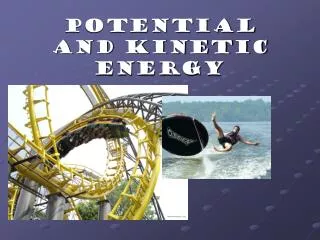
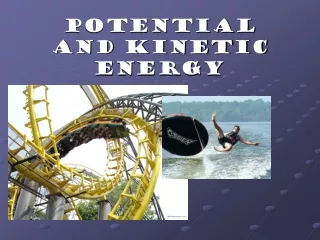
Interchangeable Forms of Energy • Rollercoaster • As the car is lifted up to the top- force is equal to? • F of g times the mass plus passengers over a distance h, where h is the height of the track • At the top • Maximum PE, PE = mgh • As the car begins descent • Acquires KE • Looses height and PE • Propose what will happen in terms of E at the very bottom • Propose what will happen in terms of E as the car begins second hill
Conservation of Energy Law • In a closed system, neglecting any frictional forces, the total amount of kinetic and gravitational potential energy is conserved
Energy of a Falling Body • The fact that the sum of kinetic and potential energies must be conserved provides us with an easy way to a analyze the fall of an object • What would be a good statement that describes the KE and PE energy in terms of a falling object • KE at the end of a fall is equal to PE at the beginning • Initial potential energy = final kinetic energy • Equation- mgh = ½ mv² • Cancel mass- gh= ½v², or v = square root of 2gh* • Therefore the speed of the objects at the end of the fall is independent of the object’s mass • More explanation on next slide.
Continued • Equation from falling body
Challenge 1 • Would you rather be hit by a 1 kilogram mass traveling 10 meters per second or a 2 kilogram mass traveling 5 meters per second? • Hint-do the math
Challenge 2 • A woman weight lifter can lift a 150-lb weight from the floor to a stand 3.5 feet off the ground. What is the total work done by the woman in joules?
Challenge 3 • You throw a softwall (250 g) straight up into the air. It reaches a maximum altitide of 15 meters and then returns to you (assume a departure and return to ground level). • What is the GPE in joules of the ball at its heights position? • What is the KE of the ball as it leaves your hand? (assume there is no E losses while it is in the air) • What is the KE of the ball as it returns to your hand? • From the KE, calculate the velocity of the ball.