The Government's Impact on Theatre: Censorship, Licensing, and Artistic Expression
This exploration examines the significant influence of government on theatrical expression throughout history, focusing on the case study of "The Marriage of Figaro" by Beaumarchais, which faced bans and censorship from Louis XVI and the Vienna authorities. It analyzes the impact of laws such as the Licensing Act of 1737 in England, which curtailed theatrical freedom, and highlights the varying roles of state subsidization and regulation in countries like France and Germany. The study also reflects on modern implications of censorship in the arts, as seen in cases involving the National Endowment for the Arts in the USA.

The Government's Impact on Theatre: Censorship, Licensing, and Artistic Expression
E N D
Presentation Transcript
Marriage of Figaro http://www.youtube.com/watch?v=vPkiLseVfBE • 2:43-4:10 and 5:42-7:40 • The Marriage of Figaro by Beaumarchais • Banned by Louis XVI, but loved by Marie Antoinette , shown to King in 1784 • (French Revolution 1789) • Play also banned in Vienna
18th century controls on theatre • England – Patent theatres and the Licensing Act of 1737 • France – Subsidized three state theatres and placed restrictions on all other theatres • Germany – states provided subsidies to theatres.
England • Charles II issued two patents (licenses) to operate theatres to Killigrew and Davenant. • The patents were gradually sold off into shares • By 1737, Drury Lane and Covent Garden were the two patent theatres • Act of 1737 issued due to insult to Robert Walpole
Prime Minister Question Time • http://www.youtube.com/watch?v=ngMs_4I1__o • http://www.youtube.com/watch?v=QpZhugomNJE
Licensing Act of 1737 • Applied to “tragedy, comedy, opera, play, farce, or other entertainment of the stage, for gain, hire or reward” • Limited plays to City of Westminster (London) • Lord Chamberlain’s approval required for all plays • L.C. control until 1968
Licensing Act 1843 • Lord Chamberlain has to have a good reason to ban • Could ban if "it is fitting for the preservation of good manners, decorum or of the public peace so to do” • Allowed local governments to license theatres, the patent theatre system no longer in effect.
Effects – New forms • Burletta • 3 Act play with 5 or more songs per acts • Melodrama • Music + Drama • Later - Music Hall • Burlesque
France • Three subsidized theatres • CommedieFrancaise • Opera • CommedieItalienne
Boulevard Theatre • Located on Boulevard du Temple • Catered to popular tastes • Could produced shows more popular that the shows in subsidized theatres
Boulevard Forms • Comic opera • Pantomime • Melodrama • Variety • Later vaudeville
State subsidized theatres • Rulers established theatres • Some gave significant financial support beyond box office receipts • Stability • Government controlled theatre through the reward of financial support.
German Melodrama • Not need to avoid regulation • Develop out of theatrical interest in manipulating emotions in theatre through music
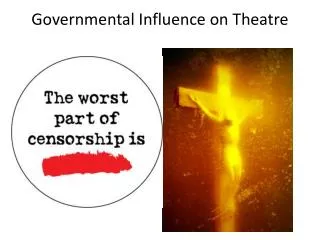
Governmental Influence • Censorship ex. Saved • Licensing – ex. Patent theatres • Regulation -ex. Licensing Act 1737 • Political pressure ex. Red Scare in USA/ USSR and theatre • Funding – NEA
Censorship in America • 1655 a play know as The Bear and the Cub was performed in Virginia • The actors were arrested on the charge of public wickedness • They were latter released
Censorship in America • 1750 the General Court of Massachusetts prohibited stage plays and theatrical entertainments of any kind • 1759, the House of Representatives in the Colony of Pennsylvania passed a law forbidding plays and acting. • 1761 Rhode Island passed a law preventing theatre from being performed • Northeast generally did not tolerate theatre due to heavy Puritan influences
NEA Four • Karen Finley, Tim Miller, John Fleck, and Holly Hughes
NEA vs. Finley • 1990 law requiring the National Endowment for the Arts (NEA) to consider “general standards of decency and respect” in the awarding of federal arts grants on behalf of performance artist • “NEA Four" received funding then lost it on the basis of decency,
NEA Four • they challenged the NEA’s decision based on freedom of speech. • 1998 Supreme Court ruled in an 8-1 opinion that the 1990 “standards of decency” statute was constitutional. As a result, NEA can deny funding based on the grounds of decency.