Understanding Passive Transport: Solute, Solvent, and Dynamic Equilibrium
This overview explains passive transport mechanisms for solutes and solvents in biological systems. It highlights the roles of solutes (the substances being dissolved) and solvents (the substances dissolving) in creating solutions. Key concepts include dynamic equilibrium, diffusion, and osmosis, alongside the importance of movement along concentration gradients. The terms isotonic, hypotonic, and hypertonic are defined to aid in differentiating solutions. Additionally, facilitated diffusion is covered, detailing substances such as water, glucose, and amino acids that move across membranes without energy input.

Understanding Passive Transport: Solute, Solvent, and Dynamic Equilibrium
E N D
Presentation Transcript
Solute vs. Solvent • Solute = substance to be dissolved • Solvent = substance doing the dissolving • Solute + solvent = solution
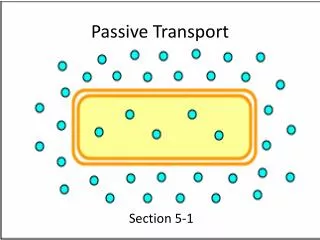
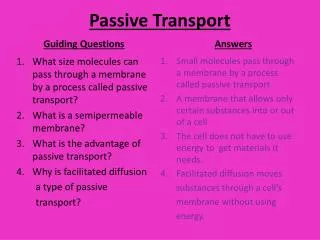
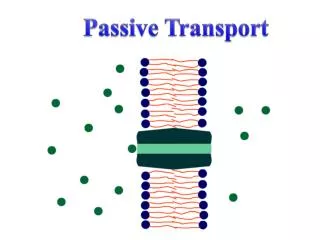
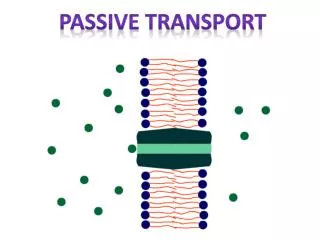
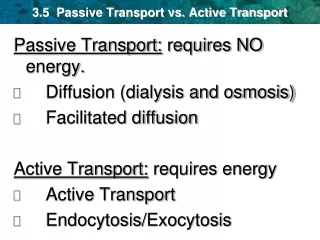
Passive Transport • NO input of cellular energy required! • Molecules move from high concentration to low concentration • “Down the concentration gradient”
What diffuses into and out of cells? • Atoms • Small molecules • Non-polar molecules • Examples?
This membrane is NOT permeable to sugar 30% Sugar ___% Water 70% Sugar ___% Water
Terms to compare solutions • Isotonic = solute and solvent concentrations are equal • Hypotonic = solution with less solute (more water) • Hypertonic = solution with more solute (less water)
Beaker A Beaker B Beaker C 100 % Water ____% Sugar 40% Sugar 90% Water ___% Water • What is the solute concentration of Beaker B? • What is the solvent concentration of Beaker C? • What would the solvent concentration be for a solution that is isotonic to Beaker B?
What is moved via facilitated diffusion? • Water • Amino acids • Glucose • Nucleotides