Download

1 / 8
90 likes | 212 Vues
The Roman Empire faced significant decline after 180 A.D., characterized by weak leadership and violent reigns, with 20 emperors ruling between 235 and 284. Challenges such as invasions, military dictatorships, inflation, and increased taxation exacerbated the crisis. Reforms by emperors Diocletian and Constantine aimed to stabilize the empire by adopting absolute monarchy, dividing the realm into Eastern and Western sections, and promoting Christianity. However, invasions by various tribes ultimately led to the fall of the Western Empire in 476 A.D., while the Eastern Empire endured for another millennium.

E N D
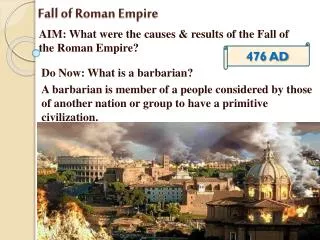
The Fall of Roman Empire 6.5 pp 188-191
The End of the Pax Romana • After 180 A.D., the Roman Emperors were weak rulers • Between 235 and 284, 20 emperors ruled- 19 of them died violently
Problems facing Rome • Weak leaders led to military dictatorships • Threat of invasions • Army grew too large • Increased taxes led to inflation • Value of money goes down • Prices go up
Reforms • 2 Emperors slowed down the decline of the empire • Diocletian • Made the Empire an absolute monarchy • Divided Empire into Eastern and Western sections • Appointed a co-emperor to rule in the west • Each emperor had an assistant to help rule • Increased size of army to deal with invasions • Strictly regulated Roman society
Reforms • Constantine • Supported Christianity • Built a new capital in the Eastern Empire • Byzantium became Constantinople
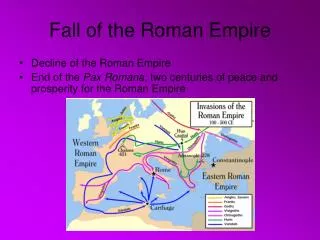
Invaders • From Germany • Visigoths – attacked Rome in 410 • Ostrogoths • Vandals – attacked Rome in 450 • From Central Asia • Huns - led by Attila – attacked in 451
End of the Western Empire • 476 – Odoacer, a barbarian chief, conquered the Western Emperor • The Western Empire never recovered • The Eastern Empire lasted another 1000 years as the Byzantine Empire