DIVISIBILITY RULES
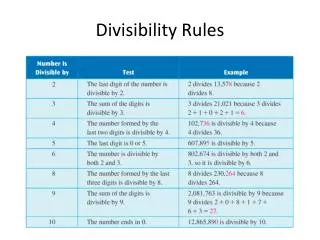
Mastering divisibility rules can greatly simplify your calculations. This guide outlines essential rules to determine if one number is divisible by another. Learn straightforward methods: a number is divisible by 2 if it’s even; by 5 if it ends in 0 or 5; by 10 if it ends in 0; by 3 if the sum of its digits is divisible by 3; and by 9 if the sum is divisible by 9. Additionally, a number is divisible by 6 if it is even and divisible by 3. Utilize these rules for fast and accurate number evaluations.


DIVISIBILITY RULES
E N D
Presentation Transcript
DIVISIBILITY RULES • The following rules will help you determine if a number is divisible by another number. • Divisible means to divide into evenly.
A number is divisible by 2 if: • it is an even number. • An even number ends with 0,2,4,6,8. • Example: 496- ends with an even number. 496 is divisible by 2.
A number is divisible by 5 if: • the ones digit is 0 or 5. • Example #1: 680 – ends with a 0 680 is divisible by 5. • Example #2: 965 – ends with a 5 965 isdivisible by 5.
A number is divisible by 10 if: • the ones digit is a 0. • Example: 950 – ends with a 0 950 is divisible by 10.
A number is divisible by 3 if: • the sum of the digits is divisible by 3. • Example: 861: 8 + 6 + 1 = 15 and15 3 = 5 861 is divisible by 3
A number is divisible by 9 if: • the sum of the digits is divisible by 9. • Example: 837: 8 + 3 + 7 = 18 and18 9 = 2 837 is divisible by 9
A number is divisible by 6 if: • it is even AND it is divisible by 3. • Example: 864 - it is even AND 8 + 6 + 4 = 18 and18 3 = 6 864 – is divisible by 6