
Early vs Delayed Oxytocin Infusion for Labor Augmentation in Nulliparous Women: A Randomized Trial
This randomized controlled trial explores the effects of early versus delayed oxytocin infusion on the obstetrical and neonatal outcomes in nulliparous women experiencing prolonged spontaneous labor. The study involved healthy women allocated to standard (early oxytocin) or expectant care (delayed oxytocin) groups. Results showed early intervention significantly reduced the time from randomization to delivery without affecting delivery mode or epidural frequency. The Apgar scores at five minutes were comparable between groups, emphasizing safety in early augmentation.

Early vs Delayed Oxytocin Infusion for Labor Augmentation in Nulliparous Women: A Randomized Trial
E N D
Presentation Transcript
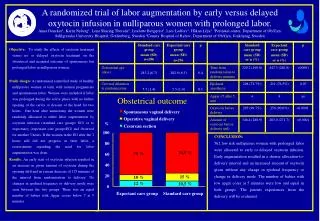
A randomized trial of labor augmentation by early versus delayed oxytocin infusion in nulliparous women with prolonged labor.Anna Dencker1, Karin Nyberg1, Lena Skaring Thorsén2, Liselotte Bergqvist1, Lars Ladfors1, Håkan Lilja1. 1Perinatal center, Department of Ob/Gyn, Sahlgrenska University Hospital, Gothenburg, Sweden 2County Hospital of Ryhov, Department of Ob/Gyn, Jönköping, Sweden Objective:To study the effects of oxytocin treatment versus no or delayed oxytocin treatment on the obstetrical and neonatal outcome of spontaneous but prolonged labor in nulliparous women. Study design:A randomized controlled study of healthy nulliparous women at term with normal pregnancies and spontaneous labor. Women were included if labor was prolonged during the active phase with no further opening of the cervix or descent of the head for two hours. One hour after amniotomy the women were randomly allocated to either labor augmentation by oxytocin infusion (standard care group= SG) or to expectancy (expectant care group=EG) and observed for another 3 hours. If the women in the EG after the 3 hours still did not progress in their labor, a reassessment regarding the need for labor augmentation was done. Results:An early start of oxytocin infusion resulted in an increase in given amount of oxytocin during the opening shift and in a mean decrease of 125 minutes of the interval from randomization to delivery. No changes in epidural frequency or delivery mode were seen between the two groups. There was an equal number of babies with Apgar scores below 7 at 5 minutes. Obstetrical outcome Spontaneous vaginal delivery Operative vaginal delivery % Cesarean section 100 CONCLUSION: 562 low risk nulliparous women with prolonged labor were allocated to early or delayed oxytocin infusion. Early augmentation resulted in a shorter allocation-to-delivery interval and an increased amount of oxytocin given without any change in epidural frequency or change in delivery mode. The number of babies with low apgar cores at 5 minutes were low and equal in both groups. The parents experiences from the delivery will be evaluated. 80 74,5 % 78 % 60 40 20 15 % 10 % 12 % 10,5 % 0 Expectant care group Standard care group