Syntax and Logic Errors in C++ Programming Assignments
This assignment covers identifying syntax and logic errors in various C++ code snippets. The tasks include analyzing given code portions that feature incorrect function implementations, pointer usage, array declarations, and recursion issues, along with expected outputs. Students are expected to demonstrate their understanding of C++ functions, templates, and pointers. Assignments are rounded off with comprehensive topics on arrays, pointers, and functions due next Tuesday. Homework will be posted today and is due on Friday.

Syntax and Logic Errors in C++ Programming Assignments
E N D
Presentation Transcript
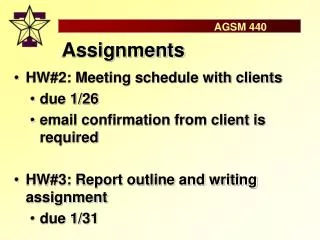
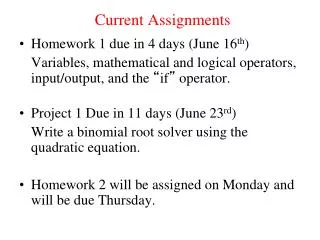
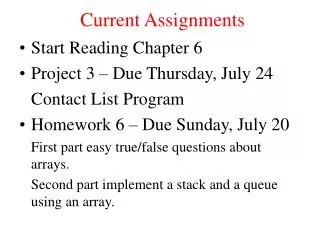
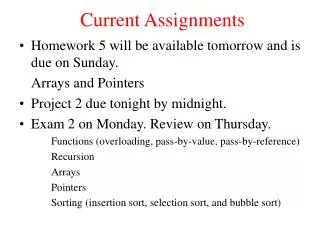
Current Assignments • Project 3 has been posted, due next Tuesday. Write a contact manager. • Homework 6 will be posted this afternoon and will be due Friday. More pointers and arrays.
Exam 2 • Functions (templates overloading etc.) • Recursion • Static Arrays • Pointers (including function pointers) • No Sorting
Sample Problem Find the syntax errors: Int foo( int int ); Int main() { foo( 3, 4 ) return 0; } Int foo( x, y ) { return x + y; }
Sample Problem Find the syntax errors: float foo( int 4, int 5 ); int main() { foo( 3.0, 4 ); return 0; } int foo( float x, float y ) { return x + y; }
Sample Problem Find the syntax errors: float foo( int x = 5.0 , int y = 5.0 ); int main() { foo( 3.0 ); return 0; } float foo( float x, float y ) { return x + y; }
Sample Problem Find the syntax errors: float foo( &int x = 5 , &int y = 5 ); int main() { foo( 3 ); return 0; } float foo( &int x, &int y ) { return x + y; }
Sample Problem Find the syntax errors: float foo( int& x = 5 , int& y = 5 ); int main() { foo( 3 ); return 0; } float foo( int& x, int& y ) { return x + y; }
Sample Problem Find the syntax errors: template<typename T> T foo( T x, T y ) int main() { foo( 3.0 ); return 0; } T foo( T x, T y ) { return x + y; }
Sample Problem Find the syntax errors: #include <iostream> using namespace std; int main() { int y = 5; int* x = NULL; x = y&; cout << (*x) << “==“ << y << endl; return 0; }
Sample Problem Find the syntax errors: #include <iostream> using namespace std; int main() { int y = 5; int x = NULL; x = &y; cout << x << “==“ << &y << endl; return 0; }
Sample Problem Find the syntax errors: #include <iostream> using namespace std; int main() { int[10] y = {5}; cout << y[-1] << “==“ << y[10] << endl; return 0; }
Sample Problem Find the syntax errors: #include <iostream> using namespace std; int main() { int array[11.5]; return 0; }
Sample Problem Find the syntax errors: #include <iostream> using namespace std; int main() { constant int x; int array[x]; return 0; }
Sample Problem Find the syntax errors: #include <iostream> using namespace std; int main() { int z; int* x; int y[10][2]; x = y[1][2]; // can't assign int to int* x = &(y[5][0]); // x = &(y[5]) only works on some compilers z = y[4]; // can’t assign an int* to an int return 0; }
Sample Problem Find the logic error: #include <iostream> using namespace std; int main() { int array[100]; for( int i = 1; i <= 100; i++ ) { array[i] = 2*i; } }
Sample Problem Find the logic error: #include <iostream> using namespace std; void foo( int* x ); int main() { int* x = NULL; foo(x); cout << (*x) << endl; } void foo( int* x ) { int y = 6; x = &y; // Returning the address of a local variable }
Sample Problem Find the logic error: #include <iostream> using namespace std; int* foo(); int main() { cout << foo() << endl; } int* foo() { int a[10] = {0}; return a; // a is the address of array a, its really a pointer }
Sample Problem What does this code snippet print: int array[4][3]; for( int i = 0; i < 3; i++ ) { for( int j = 0; j < 4; j++ ) { array[j][i] = i*j; } cout << array[i][i]; } 014
Sample Problem What does this code snippet print: char array[] = “this is\0a test”; for( int i = 0; array[i] != ‘\0’; i++ ) { cout << array[i]; } This is
Sample Problem What does this code snippet print: char* foo( char* a1 ); char* bar( char* a1 ); int main() { char test[] = "test1"; cout << test << “ “ << foo( test ) << “ “ << bar( test ) << endl; return 0; } char* foo( char* a1 ) { a1[4] = '2'; return a1; } char* bar( char* a1 ) { a1[4] = '3'; return a1; } test1 test2 test3\n
Sample Problem What does this code snippet print: void foo( int x ); void bar( int& x); int main() { int y = 5; cout << y << endl; foo(y); cout << y << endl; bar(y); cout << y << endl; return 0; } void foo( int y ) { y = y+1; } void bar( int& y ) { y = y+1; } 5 5 6
Sample Problem What does this code snippet print: int foo( int x ); int main() { foo(-2); return 0; } int foo( int y ) { if ( y < 4 ) { cout << y << “ “; y = foo( y + 1); } cout << y << “ “; return y; } -2 -1 0 1 2 3 4 4 4 4 4 4 4
Sample Problem What does this code snippet print: char* foo( char* y, const int size ); int main() { const int size = 15; char* test = “This is a test”; cout << foo( test, size ); return 0; } char* foo( char* y, const int size ) { char x[ size ]; for ( int i = 0; i < size; i++ ) { x[i] = y[size-i-2]; } x[size - 1] = ‘\0’; // Add a NULL character to the end return x; } tset a si sihT
Sample Problem What does this code print? #include <iostream> using namespace std; float foo( float x = 4, float y = 3); float bar( int x, float (*y) (float x = 4, float y = 3) ); int main() { cout << bar( 4, foo ) << endl; return 0; } float foo( float x, float y) { return (x/y); } float bar( int x, float (*y) (float x = 4, float y = 3) ) { return y( x ); }
Sample Problem Write the definition for a function that given an array of 20 integers computes the median value. Write a complete program that given an array returns a pointer to a copy of that array. Write a recursive function to subtract one positive number from another. Write an iterative function definition that concatenates two strings. Write a recursive function definition to concatenate two strings.