Enhancing Writing Skills in English Learners: Strategies for Effective Instruction
360 likes | 516 Vues
This resource focuses on effective writing instruction for English learners, emphasizing the need for diverse approaches to meet individual student needs. It highlights informal writing practices that foster fluency, including journal writing and responses to reading. It also discusses the writing process, genre writing, and collaborative strategies. Quotes from students reflect the emotional and social aspects of writing, while cited references provide a theoretical foundation for the strategies presented. Ideal for educators seeking to improve writing outcomes in diverse classrooms.


Enhancing Writing Skills in English Learners: Strategies for Effective Instruction
E N D
Presentation Transcript
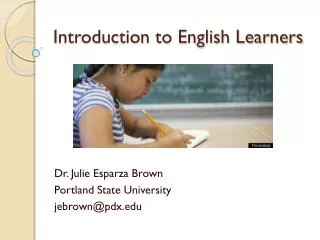
Teaching Writing to English Learners Susan Davis Lenski Portland State University sjlenski@pdx.edu
Sign In • Write your name and answer the question on one of the sheets in the room.
What is Good Writing? The Things I Need The things I need are in this list And in this list, there is: A band-aid to heal my soul, Because of how cruel some people can be; A paper clip to band together my friends and me So we can respect each other’s feelings; A light to brighten my day So I can be happy and enjoy myself; A box to keep these items in So I always know where they are And can use them whenever I need them. Sheree Brouillette Third Grade
“No single approach to writing instruction will meet the needs of all students.” (p. 11) Writing Next (2006)
Informal Writing • Builds writing fluency • Every day! • Not formally graded • Response to reading • Journal writing • Writing to learn “Writing is the mind traveling—destination unknown.”
Process Writing (Writing Workshop) • Develops skills and abilities • Some teacher directed and some student selected topics • Process through publication (sharing) • Teacher provides instruction on writing. • Ongoing. At least one publishable piece per 1-3 weeks. • Format follows content!
Kindergarten (September) My dog had puppies.
Genre Writing • Teach organizational patterns of writing (narrative, expository, persuasive) • Six traits/rubrics • “Business writing” • Writing process is condensed • Once every two weeks
Putting it Together Dear Dr. Lenski, Scratch Wisconsin off your list of places to visit! The weather is bad. There are lots of tornadoes and lots of snow. If you camp near a lake, the loons will keep you awake all night. If you catch a big fish, he might pull you into the water. If you go to a hockey game, you might get hit by a puck. If you buy a souvenir and drop it, it’s gone. I think you should stay home this summer. Troy, 2nd grade
References • Educational Leadership, October 2004. • Graham, S., & Perin, D. (2007). Writing next: Effective strategies to improve writing of adolescents in middle and high schools. New York: Carnegie Corporation. • Indrisano, R., & Squire, J.R. (Eds.). (2000). Perspectives on writing: Research, theory, and practice. Newark, DE: International Reading Association. • MacArthur, C.A., Graham, S., & Fitzgerald, J. (Eds.). (2006). Handbook of writingresearch. New York: Guilford. • National Commission on Writing in America’s Schools and Colleges. (2003). The neglected “R”: The need for a writing revolution. New York: College Entrance Exam Board. • National Writing Project. (2006). Becausewriting matters. San Francisco, CA: Jossey-Bass.