Exploring the NuMI Off-Axis Experiment: Physics, Detection, and Neutrino Oscillation
This document outlines the NuMI (Neutrinos at the Main Injector) off-axis experiment aimed at investigating neutrino oscillations, specifically determining the mixing parameters Δm²₃₂ and sin²θ₂₃. It discusses the experimental setup, including the choice of off-axis geometry for better sensitivity, the utilization of scintillator and resistive plate chambers, and challenges such as background noise. The proposed sites in Canada and the U.S. for construction, as well as the detectors required to achieve a fiducial mass of over 50 kton, are also covered. The combination of techniques could reveal key insights into neutrino properties.

Exploring the NuMI Off-Axis Experiment: Physics, Detection, and Neutrino Oscillation
E N D
Presentation Transcript
NuMI Off-Axis Experiment Alfons Weber University of Oxford & Rutherford Appleton Laboratory EPS2003, AachenJuly 19, 2003
Content • What is the physics? • Why off-axis? • The beam • The site • What experiment to build? • Scintillator • Resistive plate chambers • (Liquid Argon) • Sensitivity
What is the Physics? • Precision Experiment to determine • m23 • sin2223 • Look for sub-dominant oscillation mode • sin213 • Needed: low background • Low e beam contamination • Few wrong energy neutrinos
Why Off-Axis NC (visible energy), no rejection nm spectrum NuMI beam can produce 1-3 GeV intense beams with well defined energyin a cone around the nominal beam direction ne background ne (|Ue32| = 0.01)
Canada U.S. Soudan L. Superior Possible Sites • NuMI beam • 120 GeV protons from FNAL main injector • 3-15 GeV neutrinos • 3.8x10²⁰ PoT / year • 0.5 MW beam power • Baselines • 700-950 km • Several sites with infrastructure • Road • Electricity • Network
Experimental Challenge • Small signal • huge # NC • Surface detector • No or light over-burden • cosmic • induced n • But:Duty factor 10-5
Detector Challenge • NC versus Electron CC separation • Fine grain • Low Z • Build affordable & massive detector • 50+ kton fiducial mass • >400k readout channels • Technologies: • Solid scintillator (MegaMINOS, but not Mton) • Liquid scintillator • Glass RPCs • (Liquid Argon TPC)
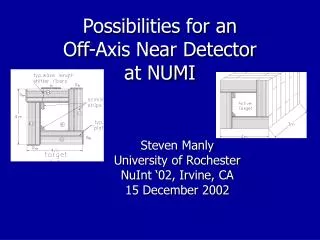
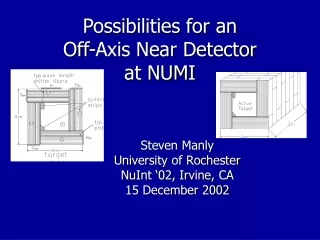
Solid/Liquid Sintillator • Alternating horizontal and vertical scintillator planes • Passive material: woodOriented Strand Board (density .6 - .7 g/cm3) • Sampling: 1/3 rad. length Fiducial fraction (1 m cut at all edges) 80% readout 15 m 180 m readout readout 9.4 tons 6 = 1 plane 5300 = detector 48 ft 15 m 15 m 885 planes = detector 8 in Scintillator modules 4 ft 8 ft 8 ft
MINOS WLS Fiber Relative Light Yield Length in cm Scintillator and WLS Fibre • Scintillator Length 15 m • Looped fibre readout • Scintillator Material • Solid • MINOS like co-extruded (3.8x1 cm2) • Liquid • Bicron 517 L (3.8x2.9 cm2) • WLS Fiber • Kuraray (0.7 mm ø) • Photodetector • APD • PMT: M64 400,000 m2 ( 16 x MINOS) ( 2 x MINOS) 680,000 channels ( 30 x MINOS)
Glass RPCs / LSTs • Used successfully • Belle: 4 years operation • Virginia Tech: 5 years testing Wood/plastic absorber
Signal & BG Events typical signal event BG event Fuzzy track = e- Clean track = muon 2 tracks = π0
Phase I (2008-2014) 4x10²⁰ PoT / year 50 kton detector (fiducial) 1.5 years neutrinos 5 years anti-neutrinos Phase II (2014-2020) A factor of 25 more:PoT x detector mass 1.5 years neutrinos 5 years anti-neutrinos Physics Reach (I)
Physics Reach (II) • Some Math: • need more than one experiment to determine oscillation parameters P (nm ne) = P1 + P2 + P3 + P4 A. Cervera et al., Nuclear Physics B 579 (2000) 17 – 55, expansion to second order in
Physics Reach (III) • Measurement is oscillation probability • Depends simultaneously on: • Mass hierarchy • CP phase • Mixing angles Typical Errors
Summary • The NuMI OA group is seriously trying to bring froward a credible & affordable proposal • Combination of • JPARC/SuperK and NuMI OA • neutrino and anti-neutrino running • might reveal neutrino mixing parameters • Masses & hierarchy • Angles • CP phase • For more information: http://www-off-axis.fnal.gov
Liquid Argon TPC • Excellent pattern recognition capabilities • High efficiency for electron identification • Excellent e/p0 rejection