THE CENTRAL NERVOUS SYSTEM
1.44k likes | 1.46k Vues
Explore the embryonic development of the brain and the organization of the central nervous system. Learn about brain ventricles, cerebral hemispheres, cortical function, and neuroimaging techniques.


THE CENTRAL NERVOUS SYSTEM
E N D
Presentation Transcript
EMBRYONIC DEVELOPMENT • At three weeks’ gestation, the ectoderm forms the neural plate, which invaginates, forming the neural groove, flanked on either side by neural folds • By the fourth week of pregnancy, the neural groove fuses, giving rise to the neural tube, which rapidly differentiates into the CNS • The neural tube develops constrictions that divide the three primary brain vesicles: • Prosencephalon (forebrain) • Mesencephalon (midbrain) • Rhombencephalon (hindbrain)
REGIONS AND ORGANIZATION • The basic pattern of the CNS consists of a central cavity surrounded by a gray matter core, external to which is white matter • In the brain, the cerebrum and cerebellum have an outer gray matter layer, which is reduced to scattered gray matter nuclei in the spinal cord
VENTRICLES • The ventricles of the brain are continuous with one another, and with the central canal of the spinal cord. • They are lined with ependymal cells, and are filled with cerebrospinal fluid • The paired lateral ventricles lie deep within each cerebral hemisphere, and are separated by the septum pellucidum • The third ventricle lies within the diencephalon, and communities with the lateral ventricles via two interventricular foramina • The fourth ventricle lies in the hindbrain and communicates with the third ventricle via the cerebral aqueduct
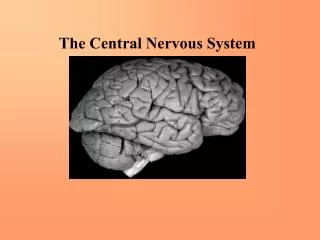
CEREBRAL HEMISPHERES • The cerebral hemispheres form the superior part of the brain, and are characterized by ridges and grooves (convolutions) called gyri (elevated ridges of tissue) and sulci (hollow grooves) • Deeper grooves called Fissures separate large regions of the brain • The cerebral hemispheres are separated along the midline by the longitudinal fissure, and are separated from the cerebellum along the transverse cerebral fissure • The five lobes of the brain separated by specific sulci (all but the last named for the cranial bone that overlie them) are: frontal, parietal, temporal, occipital, and insula ( buried deep within the lateral sulcus: equilibrium) • The cerebral cortex is the location of the conscious mind, allowing us to communicate, remember, and understand
CEREBRAL HEMISPHERES • The two hemispheres are largely symmetrical in structure but not entirely equal in function • There is a lateralization (specialization) of cortical function • NO function area of the cortex acts alone and conscious behavior involves the entire cortex in one way or another
NEUROIMAGING • Shows that specific motor and sensory functions are localized in discrete cortical areas called DOMAINS • Many higher mental functions, such as memory and language, appear to have overlapping domains and are spread over very large areas of the cortex
NEUROIMAGING • PET scans: • Positron emission tomography • Positron: a particle having the same mass as a negative electron but possessing a positive charge • Shows maximal metabolic activity
NEUROIMAGING • MRI scans: • Magnetic resonance imaging • Reveals blood flow
CEREBRAL HEMISPHERES • The cerebral cortex has several motor areas located in the frontal lobes, which control voluntary movement: • The primary motor cortex allows conscious control of skilled voluntary movement of skeletal muscles • The premotor cortex is the region controlling learned motor skills • Broca’s area is a motor speech area that controls muscles involved in speech production • The frontal eye field controls eye movement
CEREBRAL CORTEX • Primary motor area: conscious control of skilled voluntary movement of skeletal muscles • Premotor cortex: region controlling learned motor behavior (typing, playing musical instrument) • Frontal eye field: eye movement
CEREBRAL CORTEX • Prefrontal cortex: • Most complicated cortical region • Involved with intellect, complex learning abilities (cognition), recall, and personality • Production of abstract ideas, judgment, reasoning, persistence, long-term planning, concern for others, and conscience • In children matures slowly and is heavily dependent on positive and negative feedback • Closely linked to the emotional part of the brain (limbic system) • Plays a role intuitive judgments and mood • Tremendous elaboration of this region sets humans apart from other animals • Language comprehension and word analysis
CEREBRAL CORTEX • Somatic sensation: receives information from the general (somatic) sensory receptors in the skin and skeletal muscle and integrates the different sensory inputs (temperature, pressure, etc.) • Gustatory cortex: taste • General interpretation area: • Found in one hemisphere only (usually left) • Receives input from all incoming signals and focuses into a single thought or understanding of the situation
CEREBRAL CORTEX • Visual association area: recognizes a flower or a person’s face • Auditory association area: memories of sounds
CEREBRAL CORTEXLANGUAGE AREAS:LEFT HEMISPHERE • Broca’s area: • Motor speech area that controls muscles (tongue, lips, throat) involved in speech production • Considered to be present in only one hemisphere (usually the left) • Becomes active as we prepare to speak and even when we think about (plan) many voluntary motor activities other than speech • Wernicke’s area: • Language comprehension and articulation • Believed to be the area responsible for understanding written and spoken language • Involved in sounding out unfamiliar words • Prefrontal cortex: language comprehension and word analysis • Lateral and Ventral parts of temporal lobe: coordinate auditory and visual aspects of language when reading
CORRESPONDING AREARIGHT HEMISPHERE • Non-language dominance • Involved in body language and non-verbal emotional (affective) components of language rather than speech mechanics • Allows the lift and tone of our voice and our gestures to express our emotions when we speak • Permits us to comprehend the emotional content of what we hear ( a soft response to your question conveys quite a different meaning than a sharp reply)
LATERALIZATION • We use both cerebral hemispheres for almost every activity, and the hemispheres appear nearly identical • BUT, there is division of labor, and each hemisphere has unique abilities not shared by its partner (LATERALIZATION) • Although one cerebral hemisphere or the other “dominates” each task, the term cerebral dominance designates the hemisphere that is dominant for language
LATERALIZATION • Right Hemisphere: • 10% of people • Non-language dominant • Visual-spatial skills, intuition, emotion, artistic and musical skills, poetic, creative • Most left-handed • More often males
LATERALIZATION • Left Hemisphere: • 90% of people • Greater control over language abilities, math and logic • Most right handed
LATERALIZATION • BILATERAL: • Ambidextrous • Could be cerebral confusion: Is it your turn or mine? • Learning disabilities (dyslexia, etc.)
CEREBRAL HEMISPHERES • There are several sensory areas of the cerebral cortex that occur in the parietal, temporal, and occipital lobes • The primary somatosensory cortex allows spatial discrimination and the ability to detect the location of stimulation • The somatosensory association cortex integrates sensory information and produces an understanding of the stimulus being felt • The primary visual cortex and visual association area allow reception and interpretation of visual stimuli • The primary auditory cortex and auditory association area allow detection of the properties and contextual recognition of sound • The olfactory cortex allows detection of odors • The gustatory cortex allows perception of taste stimuli • The vestibular cortex is responsible for conscious awareness of balance
CEREBRAL CORTEX • Do not confuse the sensory and motor areas of the cortex with sensory and motor neurons: All neurons in the cortex are interneurons
Motor and Sensory Areas of the Cerebral Cortex • Red: Primary (somatic) motor cortex • Located in the precentral gyrus of the frontal lobe of each hemisphere • Central sulcus: groove between Red/Blue • Blue: Primary somatosensory cortex • Located on the postcentral gyrus of the parietal lobe, just posterior to the premotor cortex
Motor and Sensory Areas of the Cerebral Cortex • The body is typically represented upside down: the head at the inferolateral part of the precentral gyrus, and the toes at the superomedial end
Motor and Sensory Areas of the Cerebral Cortex • PRIMARY MOTOR CORTEX • The motor innervation of the body is contralateral (opposite) • The left primary motor gyrus controls muscles on the right side of the body, and vice versa • Misleading: a given muscle is controlled by multiple spots on the cortex and that individual cortical motor neurons actually send impulses to more than one muscle • In other words: individual motor neurons control muscles that work together in a synergistic way (so that one does not over react)
Motor and Sensory Areas of the Cerebral Cortex • PRIMARY SOMATOSENSORY CORTEX: • Receives information from the general (somatic) sensory receptors located in the skin and from proprioceptors in skeletal muscles (locomotion, posture, and tone) • Right hemisphere receives input from the left side of the body and vice versa
CEREBRAL HEMISPHERES • Several association areas are not connected to any sensory cortices • The prefrontal cortex is involved with intellect, cognition, recall, and personality, and is closely linked to the limbic system • The language areas involved in comprehension and articulation include Wernicke’s area, Broca’s area, the lateral prefrontal cortex, and the lateral and ventral parts of the temporal lobe • The general interpretation area receives input from all sensory areas, integrating signals into a single thought • The visceral association area is involved in conscious visceral sensation
CEREBRAL HEMISPHERES • There is lateralization of cortical functioning, in which each cerebral hemisphere has unique abilities not shared by the other half: • One hemisphere (often the left) dominates language abilities, math, and logic, and the other hemisphere (often the right) dominates visual-spatial skills, intuition, emotion, and artistic and musical skills • Cerebral white matter is responsible for communication between cerebral areas and the cerebral cortex and lower CNS centers • Basal nuclei consist of a group of subcortical nuclei, which play a role in motor control and regulating attention and cognition
BASAL NUCLEI • The precise role of the basal nuclei has been elusive because of their inaccessible location and because their functions overlap to some extent with those of the cerebellum • Role in motor control is complex • Plays a role in regulating attention and in cognition (reasoning/thinking) • Important in starting, stopping, and monitoring movements executed by the cortex • Inhibit unnecessary movements • Disorders result in either too much or too little movement as exemplified by Huntington’s and Parkinson’s disease
DIENCEPHALON • The diencephalon is a set of gray matter areas, and consist of the thalamus, hypothalamus, and epithalamus • The thalamus plays a key role in mediating sensation, motor activities, cortical arousal, learning, and memory • The hypothalamus is the control center of the body, regulating ANS activity such as emotional response, body temperature, food intake, sleep-wake cycles, and endocrine function • The epithalamus includes the pineal gland, which secretes melatonin and regulates the sleep-wake cycle