Understanding Atomic Structure, Mass, and Periodic Trends in Chemistry
This concise guide covers essential concepts in atomic structure and mass, focusing on particles like protons, neutrons, and electrons, their locations, and masses. It discusses isotopes, atomic numbers, and the periodic table's significance, including families and periods. Trends in atomic radii and ionization energies are explored, along with types of radioactivity such as alpha and gamma decay. Gain insights into why certain elements behave the way they do and how their positions in the periodic table influence their characteristics.

Understanding Atomic Structure, Mass, and Periodic Trends in Chemistry
E N D
Presentation Transcript
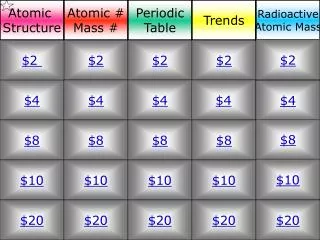
Board Atomic Structure Atomic # Mass # Periodic Table Trends Radioactive Atomic Mass Potpourri $2 $2 $2 $2 $2 $4 $4 $4 $4 $4 $8 $8 $8 $8 $8 $10 $10 $10 $10 $10 $20 $20 $20 $20 $20
Atomic #, Mass #: $4 This is what the mass number is equal to
Atomic #, Mass #: $10 This is the mass # for an atom with 8p, 10n, 8e
Atomic #, Mass #: $20 This is the number of neutrons for the isotope 58Cr
Periodic Table: $8 This is the name of the family Ca is in
Periodic Table: $10 This is the number of valence electrons P has
Periodic Table: $20 This is why the noble gases are “special”
Trends: $4 Of metal, nonmetal, or metalloid, a brittle element is this one
Trends: $10 The largest ionization energy between Be, Ca, and Sr
Trends: $20 The smallest atomic radius between Sn, Sb, and I
Radioactivity/Atomic Mass: $2 This type of radioactivity releases a helium nucleus
Radioactivity/Atomic Mass: $4 This type of radioactivity releases a lot of energy when the nucleus breaks down
Radioactivity/Atomic Mass: $8 This is created when U-235 goes through alpha decay 23592U 42He + ___
Radioactivity/Atomic Mass:$10 This is the average atomic mass for the isotopes 14N -90% and 16N -10%