Understanding Special Quadrilaterals: Identifying Shapes and Properties
60 likes | 181 Vues
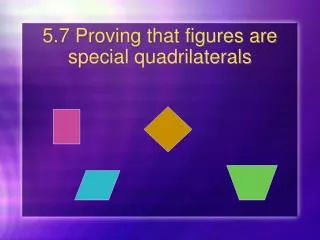
In this lesson, we explore special quadrilaterals such as parallelograms, rhombuses, rectangles, squares, kites, and trapezoids. We will graph the quadrilateral defined by points C(2,5), O(6,3), L(2,1), and D(-2,3) to determine its type. By utilizing the distance formula and slope calculations, we will prove properties like congruent sides and parallel opposite sides. This analysis will help us confirm whether the shape is a rhombus, rectangle, or another quadrilateral. Complete the assignment on page 368 to practice identifying these shapes.


Understanding Special Quadrilaterals: Identifying Shapes and Properties
E N D
Presentation Transcript
What kind of quadrilateral is it? • Possible answers: Parallelogram, Rhombus, Rectangle, Square, Kite, Trapezoid • To Decide which: Graph the answer. • If all sides are congruent: Rhombus (maybe square) • If all angles are perpendicular: Rectangle (maybe square) • See previous notes for other properties
Example • What kind of quadrilateral is at C(2,5), O(6,3), L(2,1), and D(-2, 3) • How do you know?
Solution • Graph looks like a rhombus – all the sides must be congruent (and opposite side parallel). Use the distance formula to prove.
Solution Cont’d • Pairs of sides must be parallel • Slopes of opposite sides should be equal • M = (y2 – y1)/(x2 – x1) • CO = (3-5)/(6-2) = -2/4 = - ½ • OL = (1-3)/(2-6) = -2/-4 = ½ • LD = (3-1)(-2-2) = 2/-4 = - ½ • DC = (5-3)/(2 - -2) = 2/4 = ½ • Yes, the pairs are parallel • If you need to prove that sides are perpendicular (rectangle, square), the slopes must be negative reciprocals)
Assignment • p. 368 16-24, 36-41all