
Class Discussion
E N D
Presentation Transcript
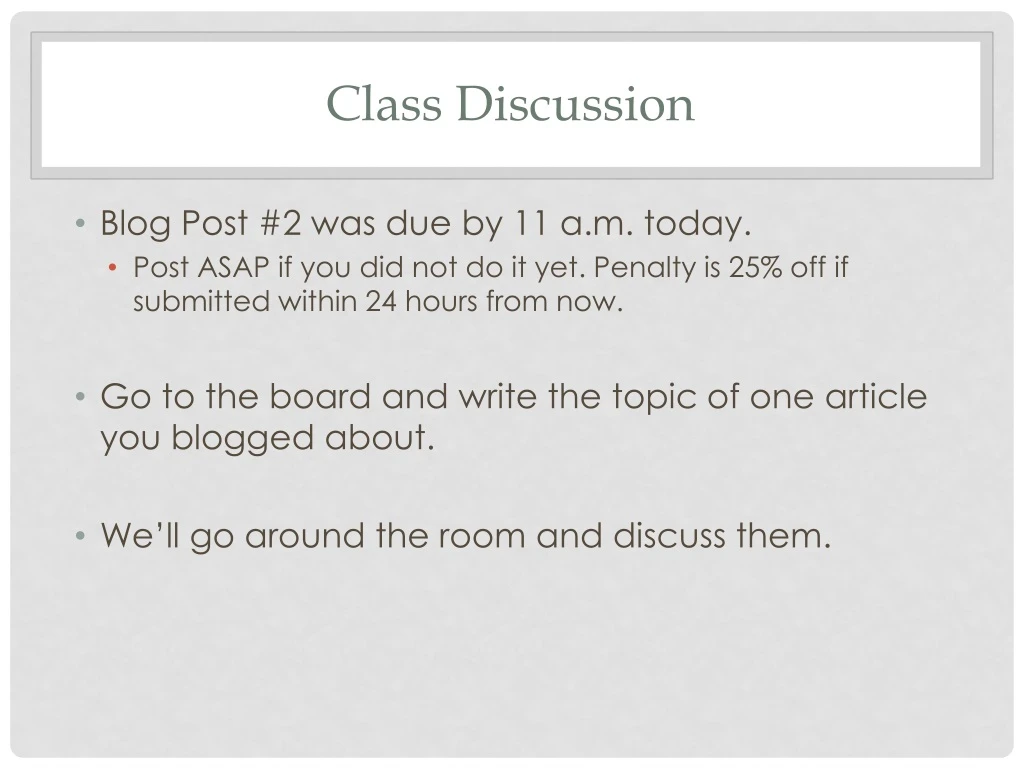
Class Discussion • Blog Post #2 was due by 11 a.m. today. • Post ASAP if you did not do it yet. Penalty is 25% off if submitted within 24 hours from now. • Go to the board and write the topic of one article you blogged about. • We’ll go around the room and discuss them.
Citizens & the News Bennett Ch. 3 Dr. Kristen landreville
The Mediator • How many of you have direct, personal experience with… • Illegal Immigration? • Middle-East Peace Process? • Foreign Trade? • How about… • Taxes? • Jobs? • Health Insurance? • Point • Many issues are not ever personally experienced.
If Love is a Battlefield, Try News • The Kingdomof Public Opinion • News is a battleground for…YOU! • Thoughts: Political attention • Group Influence: Formation of issue publics. • Behavior: Shaping political behavior (e.g., voting). • Soldiers in battle are… • Journalists • Politicians • Public relations and marketing reps • Lobbyists for interest groups • Celebrities
Opinion Management • Goal: Get their agenda and message out • Step 1: Hire communication professionals • Step 2: Keep their issue personal rather than distant • Step 3: Take advantage of the 4 information biases • Stage dramatic events (e.g., Glenn Beck / Al Sharpton rallies) • Personalize the issue (e.g., Joe the Plumber) • Inspire authority distrust (e.g., Obama’s 2008 campaign message of not trusting Republican administration and Bush-associated allies) • Assist in fragmentation of news by focusing on present, dramatic, and personal events • Step 4: Hire polling firms to confirm their agenda
But, What Public Opinion? • Issues are complex • Recent health care bill was more than 1,000 pages • News focuses on horserace • Political drama of issues • Media strategy of power players • Endorsements by power players • Public does not always have opinions • Do you have concrete opinion on all issues?
Fear & Loathing of the “Don’t Knows” • Result: Push Polls • Fear: News “pushes” respondents to have opinion • “Don’t know” can mean… • “I don’t care.” • “I’m in the middle, moderate, and can see both sides.” • “I really don’t know what I think.” • One word or phrase can change everything • Loathing: Interest groups use their language in polls • Welfare vs. poor (Smith, 1987) • Welfare led to less generosity • Welfare led to thoughts of waste and bureaucracy
Blog Post #3 • Blog Post #3 originally due on Mon. 9/13 by 11 a.m. • Now due on Wed. 9/15 by 11 a.m. • Instructions now posted to COJO 2480 tab on klandreville.wordpress.com
Contrived Pursuit of Domination • Public not utterly polarized and paralyzed • Benefits elites to be polarized • News reports issue polarization • Push pulls conducted to trigger divisions • Reality: Public-at-large is OK with their “side” losing Remember the purple!
News, What News? I Was Watching American Idol. • Media landscape reflects and reinforces social fragmentation and increasingly personalized lives.
It’s Like Getting the Attention of a 2-Year-Old • Politicians, interest groups, etc., who want our attention create messages that are: • Simple • Emotional (fear and anger) • Mass • Repeated • So that we: • Think they’re correct • Communicate (especially via interpersonal channels)
Some Tricks of the Trade • Examples of Political Campaigns Using These Tactics
Marketing the Iraq War • “From a marketing point of view, you don’t introduce new products in August,” Andrew Card, White House chief of staff. • Battle Plan, Start Date = Fall 2002: • Simple Message: A link between Saddam, Iraq, and al Qaeda exists. • Fearful Message: We can’t risk letting Saddam off the hook. • Mass Message: Make news every night. • Repeated Message: Bush, Rice, Powell, Rumsfeld, Cheney • Public Opinion Result: • Saddam helped Osama bin Laden and has WMDs. • What could have media done better in their pre-war reporting?
Let’s Revisit the Kingdom of Public Opinion • Citizens are the insurgents battling a kingdom run amok. • We feel disconnected from politics. • There is little room for alternative agendas in mainstream news. • Kingdom does not speak to us, especially young people. • Hard to reach • Unlikely to get involved • Best left to state of inattentiveness
More Data • Less than 10% of 18-34 year-olds view a nightly network news program • Vs. 23% of men and 32% of women over age 50 • 2000 election debate vs. WWE Smackdown! • Smackdown! Drew 4 times audience • 18-29 year-olds and comedy TV shows • 7 times more likely to learn about elections from comedy than voters older than 50
So I Don’t Vote • Voter Turnout Rates Among 18-29 Year Olds
Political Knowledge Quiz • Modified DelliCarpini & Keeter Political Knowledge Quiz • Write answer on paper. • How many four-year terms can the president of the United States serve? • 1 • 2 • 3 • Unlimited • Whose responsibility is it to determine if a law is constitutional or not? • President • Congress • Supreme Court
Political Knowledge Quiz • How much of a majority is required for the US Senate and House to override a presidential veto? • One-half plus one vote • Three-fifths • Two-thirds • Three-quarters • In general, thinking about political parties in Washington, would you say that Democrats are more conservative than Republicans, or Republicans are more conservative than Democrats? • Democrats are more conservative • Republicans are more conservative
Political Knowledge Quiz • Do you happen to know which party currently has the most members in the House of Representatives in Washington? • Republicans • Democrats • Which of the following countries shares a border with Afghanistan? • Russia • Pakistan • Iraq • Kazakhstan • Which of the following agencies was founded in the wake of the terrorist attacks on 9/11? • Office of Homeland Security • Delta Force • National Security Agency • Department of Civilian Defense
Political Knowledge Quiz • Would you say there is more, less, or about the same amount of crime in the US today as compared to 10 years ago? • Less • Same • More • For every dollar spent by the federal government in Washington, what percent of each dollar do you think goes to foreign aid to help other countries? • What is the Democratic candidate for Wyoming’s governor race? • What is the Republican candidate for Wyoming’s governor race?
Answers • How many four-year terms can the president of the United States serve? • 2 • Whose responsibility is it to determine if a law is constitutional or not? • Supreme Court • How much of a majority is required for the US Senate and House to override a presidential veto? • Two-thirds • In general, thinking about political parties in Washington, would you say that Democrats are more conservative than Republicans, or Republicans are more conservative than Democrats? • Republicans more conservative
Answers • Do you happen to know which party currently has the most members in the House of Representatives in Washington? • Democrats • Which of the following countries shares a border with Afghanistan? • Pakistan • Which of the following agencies was founded in the wake of the terrorist attacks on 9/11? • Office for Homeland Security • Would you say there is more, less, or about the same amount of crime in the US today as compared to 10 years ago? • Less
Answers • For every dollar spent by the federal government in Washington, what percent each dollar do you think goes to foreign aid to help other countries? • Less than 5% • What is the Democratic candidate for Wyoming’s governor race? • Leslie Peterson • What is the Republican candidate for Wyoming’s governor race? • Matt Mead • Average Correct = 5
Yes We Can! Changes In Youth Participation
Changes in Youth Participation • Some hope young people are changing • 2004 Presidential Campaign
Changes in Youth Participation • 2008 Presidential Campaign
The Youth Vote 2000 & 2004 2008
Not Just A Vegetable • 2 Views of the Audience • Passive Audience: • People are easily influenced, persuaded, and manipulated by media. • When audience is unfamiliar with issue, they are more passive. • Active Audience: • People develop interpretative strategies to help them actively construct meanings from the news. • Personal issues mean an active audience is more likely. • “What can I do to help?” – People need to feel empowered. • In what circumstances are you an active vs. passive audience member?
Yes, You Actually Learn Too! • Yes, you actually learn! • TV stimulates our brains in comprehensive ways. • TV gives us words, sounds, sights, and text to learn from. • Visuals generate more emotion, which leads to more attention and learning. • Newspapers better for learning when: • You regard issue as personally affecting you. • You already closely follow the issue. • You are motivated to dig into the issue. • Results: less personal, less episodic, and more thematic understanding of issue.
But In The End, We Are All Cognitive Misers • News is complex, confusing, and confrontational! • We take cognitive shortcuts : • Cueing • Bolstering • Weighing • Personal Organizing • Cueing: Using cues and labels from trusted and familiar reference groups. • Democrat/Republican or Pro-life/Pro-choice • Bolstering: Selecting factoids provided by cues to support arguments • Our arguments mirror reference groups. • Example: Obama wants to extend Bush-era tax cuts
But In The End, We Are All Cognitive Misers • Weighing: Using emotions in news to direct attention and learning. • Negative campaigning: We hate it. We try to ignore it. • But it works (sometimes). Why? • We forget the source of negativity. • If negativity is not addressed and countered, then we adopt those beliefs. • Solution for the attacked: “Wink and a shrug” approach. • Personal Organizing: Filtering news by one’s values, interests, experiences, and lifestyle choices • Example: Relating and understanding news stories with a “student lens”.
So Why Do We Watch News Anyways? • News for Democratic Purposes: • Learn about politics, form opinions, take political action • News for Curiosity and Surveillance: • Keep tabs on world • We like new events and novel twists on old themes. • Example: Freedom of choice related to…abortion, drugs, doctors • News for Entertainment and Escape: • Drama, conflict, emotion, intriguing characters • Art imitates life / “ripped from the headlines” • Example: Iraq War & BattlestarGalactica • Example: Law & Order on NBC • News for Social and Psychological Adjustment • Vicarious involvement • Parasocial relationships
For Next Time… • Blog Post #3: See instructions • Due Wed. 9/15 by 11 a.m. • Read Bennett, Ch. 4 on “How Politicians Make the News”