Exploring Player Culture in Gaming: Social Dynamics, Rewards, and Community Engagement
This paper reviews key themes regarding player culture in video games, such as the interplay between high and low culture, moral panic surrounding gaming, and the intrinsic rewards that games offer. It discusses Mihaly Csikszentmihalyi's concept of "flow" and the transformative experiences games can provide, including social connections and identity experimentation. The study emphasizes the significance of player communities, their shared values, and the impact of collective practices on individual satisfaction and community engagement in gaming environments.

Exploring Player Culture in Gaming: Social Dynamics, Rewards, and Community Engagement
E N D
Presentation Transcript
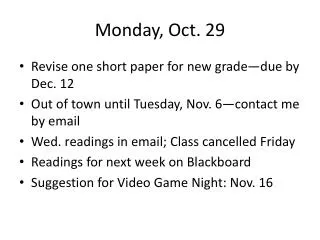
Monday, Oct. 29 • Revise one short paper for new grade—due by Dec. 12 • Out of town until Tuesday, Nov. 6—contact me by email • Wed. readings in email; Class cancelled Friday • Readings for next week on Blackboard • Suggestion for Video Game Night: Nov. 16
Public Perceptions of Gaming • Idealization of play/skepticism about play in society • Taste (Pierre Bourdieu): “a means to establish group boundaries, by signaling one’s membership to a certain social group” • High culture and low culture/pop culture • “Moral panic”/ “media panic” • GTA “Hot Coffee mod” • Smithsonian exhibit: “The Art of Video Games”
Player Culture • MihalyCsikszentmihalyi’s book Flow: state of concentration and satisfaction • “Optimal experience” • Challenge, skill • Immersion, attention, concentration • Goals and feedback • Control • Loss of self-consciousness • Transformation of time • Experiment with different identities (Sherry Turkle)—no unified self
Jane McGonigal, Reality Is Broken • “games are providing what reality cannot” • Rewarding interaction vs. passive entertainment • Intrinsic rewards • Satisfying work: clearly defined, demanding activities, direct impact of efforts • Experience of being successful, feel powerful • Social connection, share experiences, create bonds • Meaning, part of something larger than ourselves • Happiness hacking—life is hard, games make it better • Gamification
Player Communities • Game communities (within the game) • Membership • Relationships (teams, races, classes, guilds) • Commitments, reciprocity (dedication, following rules) • Shared values, practices (game behavior) • Collective goods • Duration (not persistent) • Metaculture (outside the game—fan culture, professionalization)
Aspects of Player Culture • Conflicts • Cheating • Grief play • Bots and goldfarming • Fan Culture • Mods • “Poaching” (creatively reusing content, fanfic, walkthroughs, machinima, skins, videos), from instrumental to expressive • “Leetspeak” • Professional gaming (Major League Gaming) • Virtual economies