Download

1 / 21
220 likes | 340 Vues
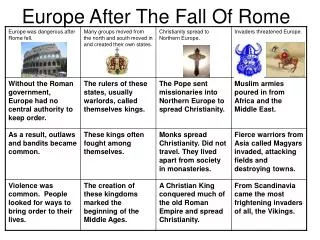
Explore the tumultuous era of Roman history from 300 to 1000 AD, highlighting the reigns of notorious emperors such as Tiberius, Caligula, Claudius, and Nero, and contrasting them with the Five Good Emperors: Vespasian, Titus, Domitian, Trajan, and Hadrian. Discover the decline of the Roman Empire, characterized by chaos and bankruptcy, and significant events like Diocletian's division of the empire, Constantine's embrace of Christianity, and the impact of barbarian invasions. This period laid the foundation for a new order in Europe.

E N D
After the Fall of Rome 300—1000 AD
Four Bad Emperors Tiberius (14 AD—37AD) Caligula (37—41) Claudius (41—54) Nero (54—68)
Five Good Emperors Vespasian (69—71) Titus (79—81) Domitian (81—96) Trajan (96—117) Hadrian (117—138)
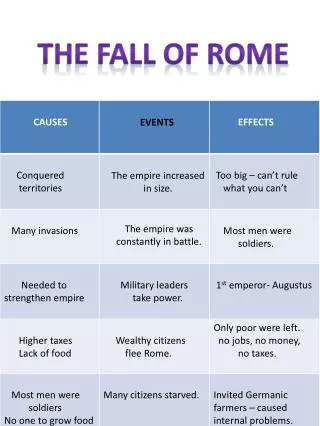
The next emperors? They were all weak “Rome changed from a kingdom of gold to a kingdom of iron and rust.” In 50 years, 190 cities bankrupt.
Diocletian (284—305) • East vs. West • Two emperors: Rome and Byzantium • Augustus vs. Caesar • Stroke in 305.
Constantine (306—337) • Christian • Council of Nicaea (325 AD) • Cross on shields • Seat of empire moved to Byzantium. • Called it Constantinople. • Rome subject to outsiders—the Huns.
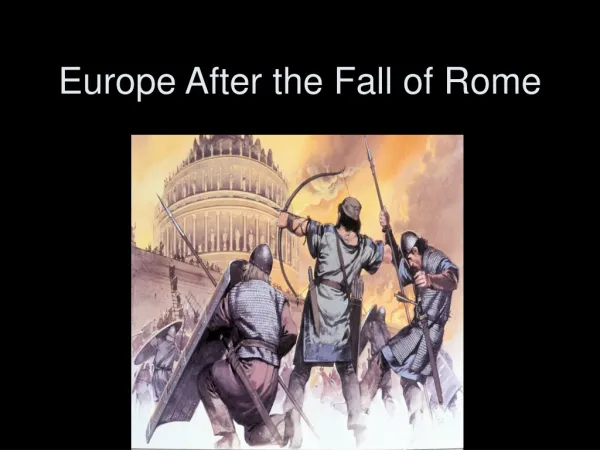
Barbarian Invasions • Huns from Far East • Leader was Attila • Visigoths—Germanic • Vandals—Spanish • Francs—French • Anglo-Saxons—England • 476 AD Odoacer rules in the West.