Download
1 / 8
80 likes | 196 Vues
Absolute dating is a scientific process used to determine the age of objects, including rocks and fossils, by measuring the decay of radioactive isotopes into stable forms. This technique relies on the ratio of unstable to stable isotopes, allowing researchers to ascertain the age of rock samples accurately. Key methods include uranium-lead dating for ancient rocks over 10 million years old, potassium-argon dating for those between 100,000 and 10 million years, and carbon-14 dating, which is effective for dating materials less than 50,000 years old.

E N D
Sci. 3-3 Absolute Dating: A measure of Time Pages 64-67
A. Absolute Dating- a process of establishing the age of an object
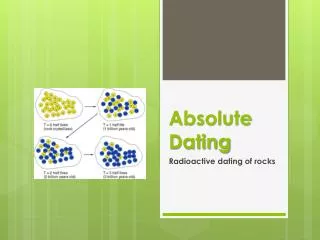
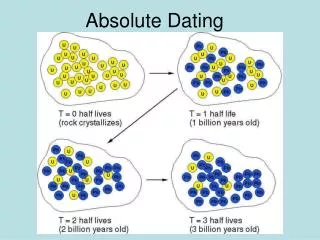
B. Radioactive Decay-a process in which radioactive isotopes tend to break down into stable isotopes of other elements
C. You can figure out the age of a rock sample if you know the rate of decay for an element in the rock sample.
D. The absolute age of samples of rocks and fossils can be determined by the ratio of unstable isotopes to stable isotopes. This is called radiometric dating.
Types of Radiometric Dating • 1. Uranium-lead- used to date rocks older than 10 million years
2) Potassium-Argon- used to date rocks between 100,000 years and 10 million years
3) Carbon-14- used to date objects less than 50,000 years old