
New Approaches to Analyze Disordered Materials: Insights from Percolation Theory
This study by Stefan Boettcher from Emory University explores new numerical and theoretical methods to examine disordered materials, particularly focusing on percolation transitions in complex networks. Collaborating with student V. Singh, the research highlights how ordinary percolation processes can cause catastrophic interruptions in transport within hierarchical networks. Additionally, extensive simulations by S. Falkner and Boettcher address finite-size corrections in Edwards-Anderson spin glasses. Their results validate longstanding theories, demonstrating significant understandings of glassy states and critical phenomena.

New Approaches to Analyze Disordered Materials: Insights from Percolation Theory
E N D
Presentation Transcript
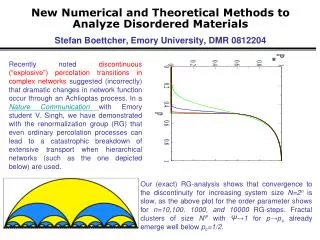
New Numerical and Theoretical Methods to Analyze Disordered MaterialsStefan Boettcher, Emory University, DMR 0812204 Recently noted discontinuous (“explosive”) percolation transitions in complex networks suggested (incorrectly) that dramatic changes in network function occur through an Achlioptas process. In a Nature Communicationwith Emory student V. Singh, we have demonstrated with the renormalization group (RG) that even ordinary percolation processes can lead to a catastrophic breakdown of extensive transport when hierarchical networks (such as the one depicted below) are used. Our (exact) RG-analysis shows that convergence to the discontinuity for increasing system size N=2nis slow, as the above plot for the order parameter shows for n=10,100, 1000, and 10000 RG-steps. Fractal clusters of size NΨwith Ψ→1 for p→pcalready emerge well below pc=1/2.
New Numerical and Theoretical Methods to Analyze Disordered MaterialsStefan Boettcher, Emory University, DMR 0812204 With extensive simulations on our computer cluster,Emory student S. Falkner and I have addressed a long-standing question for Edwards-Anderson spin glasses in aEuroPhysics Letter. The origin of finite-size corrections to ground-state energies in the glassy state had long been conjectured to be due to locked-in domain walls, such that those corrections would scale with a “stiffness” exponent y as <c0>L ~ <c0>∞ + A/Ld-y. Our data on bond-diluted lattices match that scaling with high confidence, and reproduce values of y we independently obtained from ground-state excitations on lattices up to the upper critical dimension d=6. Simulations of the Sherrington-Kirkpatrick model with Levy-couplings have been published in a Philosophical Magazine issue dedicated to D. Sherrington’s 70th birthday. Related research involved four student co-authors; all disseminated their work at the APS in Boston. I was invited for a colloquium at Syracuse University, to a conference in Les Houches, and for a new collaboration in Brazil, where I presented seminars also in Rio, Petropolis, and Natal.
